Monday, 20 December 2021

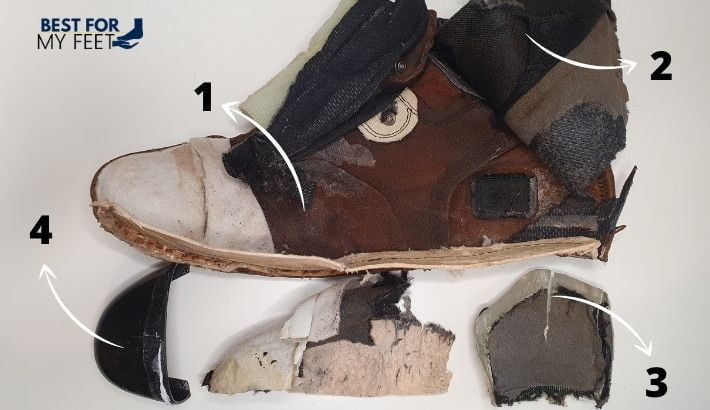
Work Boot Anatomy: What’s Inside The DeWalt Newark Steel Toe Boot?

I’ve bought these boots for my construction day job and right from the get-go I’m going to tell you that these were some of the most comfortable work boots for the money.

In this case, my friend and colleague, Peter wore the boots since I don’t have time to wear and review all the boots you’ll find on Best For My Feet.

You can read the DeWalt Newark full review here if you’re curious to know more. In this article, we’ll only talk about what’s inside this boot or at least what materials I can identify as I’m deconstructing the boot.

a pair of safety work boots from DeWalt cut in half. The model is DeWalt Newark.

About the boot

Brand DeWalt
Model Newark
Shaft height 6-inch from that arch
Heel height 1.05 inch
Color Brown
Toe cap Steel toe box
Upper Leather
Sole construction Cemented
Price Check on Amazon

How the boot was used

These safety steel toe work boots were used by my colleague Peter on a construction site where he works as a site manager He’s duties don’t involve heavy-duty tasks but he does walk a lot.

According to his smartwatch, he makes about 15000 steps per day. That’s much more than I do.

Most of the time the boots were used to walk on concrete and sometimes soft ground and mud.

How long it lasted

The boot lasted 9 months roughly. In these 9 months, Peter did somewhere around 3 million steps. Most people don’t do anywhere near this amount of steps.

The boot had to be replaced because the leather completely split around the foot ball area.

My guess is because Peter didn’t know about conditioning the leather and taking care of it in general (or he simply doesn’t have time for it). And also, don’t forget the number of steps he did wearing these boots.

Alright, let’s dig in.

Let’s start with the sole of the DeWalt Newark

1. The outsole

When I read the product description of this work boot on Amazon or DeWalt’s website it says the boots come with a TPU dual density outsole which is harder than pure rubber and will last longer since is more abrasion resistant than rubber.

The outsole is about 6mm thick.

2. The midsole

I can’t find anything about the midsole, but in my opinion, the midsole is made of EVA (Ethylene-vinyl Acetate). I say this because the midsole is very soft, kinda like foam and that’s what provides the cushioning in this boot.

It’s about 16mm thick in the heel area where you need most cushioning and about 8.5mm thick in the rest of the sole.

3. Anti puncture metal plate

A great feature to have especially if you work in anything related to construction. There’s always the possibility of stepping into a nail or screw, broken glass, and sharp-edged pipes, or exposed metal.

So in order to protect you against some of the hazards mentioned above, these DeWalt Newark boots come with a steel plate. The plate is fitted inside the midsole right under the fiberboard that keeps together the water membrane and lining.

It’s 0.2mm thick so it doesn’t add that much to the total weight of the boot. The plate weighs 37g give or take.

4. The insole

The insole is quite comfy right from the get-go so if you want to save money there and don’t buy additional inserts, these will be comfortable for the first 2-3 months.

They’re made of PU (polyurethane) and they feature moisture-wicking and anti-bacterial systems to help reduce stinky feet.

If you need arch support, they do provide a little bit. That’s decent for a normal foot. If you have plantar fasciitis or maybe you have flat feet then you might have to look for a different option.

5. Construction type

This boot’s construction is what’s known as cemented sole construction where the sole of the boot is glued to the upper of the boot. There are pros and cons to this type of boot construction but the con that most interests you is that you can not resole these boots.

Or if you find a cobbler to do it, it might not be worth it since resoling a pair of work boots is not cheap either.

6. Does this boot has a shank?

No, the Dewalt Newar doesn’t have a shank. And in all honesty, you won’t need one with these work boots.

The main reason is that the heel is very low and also the steel plate acts a little bit as a shank on this occasion. But if you really want a real shank this boot doesn’t have it.

7. Does this boot provides arch support?

Nope. This model from DeWalt doesn’t provide arch support. The footbed is very flat but if you require arch support the good news is that the insole is removable so you can add something that fits your needs.

Let’s talk about the upper of this DeWalt Newark

1. Material used in the upper

The upper contains a few different materials such as leather, fabric, and TPU as heel reinforcement.

According to DeWalt, these Newark safety work boots are made with Buffalo leather. It’s 2mm thick which is decent for a work boot but I wasn’t convinced by the quality.

2. The second layer (possible insulation)

I can’t identify the second layer in the upper that comes after the leather. It’s some kind of fabric that’s 1.6mm thick and I think it serves as insulation.

3. Is it waterproof?

On Dewalt’s website, it says this boot comes with Hydroguard® lining.

Hydroguard® is basically a PU (polyurethane) membrane that will stop water coming into your boots even if the water or moisture might still come through seems and stitches holes.

Something similar happened to my boots too. The leather cracked and allowed water to penetrate into the boot but that was all good since the membrane would still keep my feet dry until this happened.

The water membrane has a nice big hole in it due to the friction between the toe and the membrane. Now every single little drop of water comes straight into the boot.

That’s the reason why my buddy Peter stopped using these boots.

But if the membrane is in good shape, these work boots are indeed waterproof.

Parts 3 & 4 in the image above are what make the water membrane. Here’s a test of the membrane:

4. Heel counter

The heel on this boot is made of paperboard and this option makes for a very poor quality boot in terms of structure.

That’s probably the reason DeWalt went for a TPU exterior heel support. This feature will not only keep your heel in place as you walk but also will maintain the structure of the boot and even avoid some silly injuries in the heel area.

5. Padding

The boot has a lot of padding which is one of the reasons is so comfy. On the other hand that’s probably why so many reviews out there say the boot will make your feet sweat.

I mean, there’s a lot of material in this boot. The 2mm thick leather, the fabric between the leather and the water membrane, the membrane itself, and your socks …

… it’s easy to see why you could sweat in these boots.

There’s some foam padding in the tongue and around the ankle as well for added comfort!

6. Toe cap protection

an image with 4 different measurements of the steel toe cap from the DeWalt Newark work boot. We're looking at the width, thickness, height and weight of the steel toe cap.

This is a safety toe boot and it comes with a steel toe cap. So if you need a boot for construction work or any other industry that requires you a safety toe work boot, then this is a great option!

On top of the toe cap, you’ll see an anti-scuff toe guard which makes the boot a little bit more durable by not allowing the leather to get worn and damaged leaving the toe cap exposed, forcing you to replace your work boots.

The toe cap itself is quite tough and it seems that I need to up my tools game here since I couldn’t cut through the steel with my Bosch jigsaw.

You’ll see how thick it is in the image above plus how wide and tall it is in case you need to know if your feet will fit in these boots.

Last words

I hope I didn’t miss anything. Cutting my DeWalt Newark in half helped me learn a bit more about work boots and I hope it helped in any way.

Now I know why so many colleagues on my site wear these work boots. They’re an affordable pair of safety boots, they’re comfortable and they have a tone of good features.

Even though these boots are not made in America, they’re not bad at all for the money you pay for them.


Team Members Working On This Page

Victor Adrian – Editor And Webmaster

Construction Professional, driver, crane operator, cleaner, head chef … these are just some of the jobs I did in the past. Working in all these different environments taught me that having good footwear to protect your feet from different dangers at work IS PARAMOUNT for any worker! On this website, I aim to share all my knowledge and personal experience in dealing with different footwear and foot care issues, and hopefully, you can get something out of it. Enjoy!

Jessica Flynn
Jessica Flynn – Writer And Researcher

Love technology, going to the beach, taking care of my body, and writing (amongst other things). You’ll see my face around here a little bit since I’m responsible for part of the research and writing of some of the articles you’re reading on BestForMyFeet.com. I hope you’ll find our content helpful and enjoyable! See you around, thanks for reading!


source https://bestformyfeet.com/dewalt-newark-work-boots-cut-in-half/

Thursday, 16 December 2021

10 Work Boots Made In America That You Should Know About

You see, as a hardworking man, nothing irks me more than a pair of lousy work boots with low-quality materials that can’t keep up with my pace.

Many companies have moved their production overseas over the last years since it’s cheaper to mass produce and keep up with the demand for work boots.

Nothing beats the quality of a good work boot made in the US though.

Since it’s so hard to find genuine made in USA work boots, I’ve decided to dedicate this article to gather some of the top American-made work boots in one place.

a pair of old work boots and an American flag meaning that these work boots have been manufactured in the USA.

Here are some brands that still make work boots in the USA

  • White’s
  • Nicks
  • Red Wing
  • Chippewa
  • Kamik Shelter
  • Thorogood
  • Carolina
  • Carhartt
  • Danner
  • KEEN

We’ll add to the list as we discover more brands. Now, hold on to your seatbelt, because we’re about to explore some boots from each of these brands and what they have to offer.

Top 10 Made in USA work boots

In my experience, there are two types of American work boots:

  • the ones partially assembled in the USA
  • and the ones made in the USA (with the often-necessary imported parts)

To make it clear and be fully transparent, while there are many brands I’d love to add and models I want to talk about, I’ll be focusing only on brands known to make work boots in America.

Now let’s get this show on the road and get to the list! By the way, the boots are listed in no particular order.

1. White’s Work Boots

BuilderPRO By Nicks

White’s is one of those brands you only hear about when you’re on the hunt for something that will last and is designed for rugged jobs, and I have to admit that their Fire Hybrid is a perfect example of that.

These boots aren’t just made for showing off; they’re handmade for wildfires and easier break-in periods so that your foot doesn’t have to struggle while you get things done on the line of duty.

Features of the Fire Hybrid

Toe cap Soft toe
Height 8-inch tall
Upper Heavy-duty leather
Outsole Fire & Ice White Dot Hybrid Sole by Vibram
Shank Leather
Resole-able Yes

Are White’s boots made in the USA?

White’s history goes all the way back to before the US Civil War when Edward White established a one-person shoe shop in Connecticut.

Ever since, it’s kept all its facilities in the US using American-made materials while continuing to produce hand-sewn boots out of its facility in Spokane, Washington.


2. Nicks Work Boots

BuilderPRO By Nicks

I tend to be on my feet anywhere from 10 to 12 hours a day, and even more, so making sure my feet have the support and safety they need is right there at the top of the list of my priorities. 

The leather on the BuilderPro on its own makes you realize just how durable they are for any job. And thanks to its arch support and rugged build you can be sure these bad boys are going to keep you comfortable and safe for many years.

Features of the Nicks’ BuilderPRO

Toe cap Steel toe
Height 10-inch tall
Upper Heavy-duty leather
Outsole Vibram® Red X Fire lug
Arch support Yes
Resole-able Yes

Are Nick’s work boots made in the USA?

Just like White’s, Nick’s is also based in Spokane, Washington. The similarities between the North West companies don’t end there, though.

Nick’s work boots are handmade in the US, making them one of the few remaining work boot manufacturers that still build work boots in their hometown while prioritizing quality and keeping up the legacy of American-made reliability.

Nicks and White’s are the most expensive work boots on this list and not everyone would like to spend that kind of money on a pair of work boots. I know many linemen like these types of work boots.

Below you can find more affordable work boots options though.


3. Red Wing Work Boots

a pair of work boots from Red Wing that are made in America

Red Wing Supersole

Red Wing’s Supersole is one of Red Wing’s toughest boots out there that blends in premium and rugged durability with a classic Red Wing touch.

Features of the Red Wing Supersole

Toe cap Steel toe
Height 8-inch tall
Upper Full-grain leather
Electrical Hazard Yes
Shank Fibergalss

Are Red Wing boots made in the USA?

Red Wing is a pretty iconic name when it comes to working boots, but after some digging, it turns out only their Heritage lineup and a few other models are entirely made in the USA.

Another interesting fact about Red Wing is that they have their own tannery, allowing them to have greater control over the quality of their leather.

Red Wing has also partnered with the US military for generations to supply leather for soldiers’ boots since WW1.


4. Chippewa

a pair of work boots from Chippewa that are made in the USA

Chippewa Modoc

Packing in rugged protection on the inside and out, the Chippewa Madoc does one heck of a good job at keeping your feet dry while providing traction on various terrains with the added benefit of comfort throughout a shift thanks to its Ortholite® insoles.

Features of the Chippewa Modoc

Toe cap Composite toe
Insulated 400g
Height 6-inch tall
Upper 100% leather
Outsole Vibram outsole
Shank Steel

Are Chippewa work boots made in the USA?

Chippewa is one of the oldest American work boot brands that’s been around since 1901, and right up until today, a good deal of their work boots are made in their factory in Carthage, Missouri, in the good ol’ USA.

Along with other brands I’m a fan of when it comes to their craftsmanship, Chippewa work boots are well known for their premium American quality and reliable build.

They even come with a distinctive metallic American flag on their laces.


5. Kamika Work Boots

Kamika Shelter

Designed for the extreme terrains of North America and the blistering cold, Kamrik’s ShelterV boots are made using neoprene, a synthetic rubber that’s famous for its durability and resistance to temperatures, not to mention being lightweight.

Features of the Kakika Shelter

Toe cap Soft toe
Wateproof Yes
Height 12-inch tall
Upper Neoprene
Outsole Vibram outsole
Oil & Acid Resistant Yes

Are Kamik boots made in the USA?

Kamik is a Canadian family-owned company that’s been around since 1898, with about 70% of their boots made in North America.

Although it’s a Canadian brand, several of their boots clearly state where they’re made, with many of them proudly made in the USA. 

Kamik’s boots use rubber sourced from Japan, one of the key differentiators of this brand’s offerings.

You can visit their store here to find out more about these and other work boots they have in store.


6. Thorogood Work Boots

Thorogood Logger Series 9

I’ve written about Thorogood extensively on Best For My Feet, and when it comes to their Made in the USA boots, they do not disappoint, especially the Logger Series that grind through the day without breaking a sweat.

Features of the Kakika Shelter

Toe cap Steel toe
Waterproof Water-resistant
Height 9-inch tall
Upper Crazy horse leather
Outsole Vibram outsole
Shank Steel

Are Thorogood work boots made in the USA?

Thorogood’s been in the work boot business for more than 125 years from their company-owned headquarters in Wisconsin. The brand even made the US Army’s boots worn in WW1.

Many of Thorogood’s work boots are Union-made, meaning skilled workers make them in labor unions in the US.


7. Carolina Work Boots

Carolina Marlboro

Created to provide uncompromising quality on the job, Carolina’s CA8588 is one of my favorite USA-made work boots out there. It’s not only beautifully made but it’s a comfortable and rugged pair of work boots that I can always count on.

These bad boys sure do take a punch, and with the insulation in them along with the steel safety toe cap, your foot won’t feel a thing from the threats of the outside world.

Features of the Kakika Shelter

Toe cap Steel toe
Insulated 400g of Thinsulate
Height 8-inch tall
Upper Old Town Folklore Leather
Outsole Non-marking rubber outsole
Shank Steel

Are Carolina work boots made in the USA?

I know you might be thinking that with a name like Carolina, every work boot would be made in the US, but that’s not the case. They do outsource some of their work boots so make sure you read the product description before you buy.

Based on my experience and research though there are many Carolina work boots like the Ferric, Elm, and other lineups that are union-made in the company’s facility in Martinsburg, Pennsylvania, made with materials from around the world.

You can find out more about the boot either on Amazon or if you prefer, Carolina online store.


8. Carhartt Work Boots

Carhartt CMZ6340

Made in the USA with US and imported parts, Carhartt’s oil-tanned leather work boots are the complete package for a worker.

It comes with everything you need from composite toe caps that meet ASTM 2413-17 impact hazard and compression standards, along with comfortable direct-attached (cemented) polyurethane outsoles. 

Features of the Kakika Shelter

Toe cap Composite toe
Height 6-inch tall
Upper Old Town Folklore Leather
Outsole Polyurethane outsoles
Resole-able No

Are Carhartt work boots made in the USA?

Carhartt work boots are made in two primary locations, the first being in the United States with their Made in USA lineup and Mexico.

The company also sources materials for their USA-made work boots from various US suppliers in states, including Georgia and Kentucky.


9. Danner Work Boots

Danner Quarry

The Men’s Quarry by Danner is one of this brand’s most popular work boots, and I’ll tell you why: It’s comfortable, snug, badass, and has excellent craftsmanship with top-of-the-line materials.

This boot comes with a ton of features and a lot of models you can choose from. Check out Danner’s website for more or see what Amazon has to offer you prefer that.

Features of the Kakika Shelter

Toe cap Soft toe
Height 8-inch tall
Upper Full-grain leather
Outsole Vibram® Quarry
Resole-able Yes (Stitchdown Construction)
Shank Fiberglass

Are Danner work boots made in the USA?

Founded back in 1932, Danner’s work boots are Berry Compliant, a certification that meets or exceeds the strictest US Federal Trade Commission’s standards, which Danner proudly mentions on their website.

However, not all their work boots are completely made in the US. Only the ones labeled as Made in the USA are crafted from top to bottom in their factory in Portland, Oregon. So if this is important to you, make sure to read the description properly before buying.


10. KEEN Work Boots

KEEN Manchester

Don’t let the name fool you; these work boots by KEEN are as born and bred in the US as they come, with a focus on lightweight construction work inspired by the design of hiking shoes to have maximum flexibility.

Features of the Kakika Shelter

Toe cap Aluminum toe
Height 5.5-inch tall
Upper Leather
Outsole Non-marking rubber outsole
Resole-able No (cemented construction)
Shank Nylon shank

Are KEEN work boots made in the USA?

KEEN’s footwear can be divided into two parts:

  1. work boots assembled in their factory in Portland, Oregon
  2. and work boots assembled abroad

While the material used to make their work boots come from several places, in 2010, the company brought back a chunk of its manufacturing to the US and produces several models labeled as “American Built” to distinguish them from the rest.


Are work boots made in the USA worth it?

Most people go for American work boots due to their superior materials and reliable build quality, which is a valid point that I have to agree with.

However, a work boot’s safety, comfort, durability, and overall reliability aren’t limited to one factor at all. 

I know a lot of you will point out that not every work boot can be counted on, but that’s where knowing which brands to go for comes in handy to filter out the junk from the treasures, which I’ve been on a mission to find out in my reviews.

Finally, I should mention that while many work boots are not made in the US, their companies are American.

Why’s that important?

Because it means that with brands like Ariat, Thorogood, Irish Setter, and countless others that I’ve written about, you get American quality, with the occasional lower price tag.


Team Members Working On This Page

Victor Adrian – Editor And Webmaster

Construction Professional, driver, crane operator, cleaner, head chef … these are just some of the jobs I did in the past. Working in all these different environments taught me that having good footwear to protect your feet from different dangers at work IS PARAMOUNT for any worker! On this website, I aim to share all my knowledge and personal experience in dealing with different footwear and foot care issues, and hopefully, you can get something out of it. Enjoy!

Jessica Flynn
Jessica Flynn – Writer And Researcher

Love technology, going to the beach, taking care of my body, and writing (amongst other things). You’ll see my face around here a little bit since I’m responsible for part of the research and writing of some of the articles you’re reading on BestForMyFeet.com. I hope you’ll find our content helpful and enjoyable! See you around, thanks for reading!


source https://bestformyfeet.com/what-work-boots-are-made-in-the-usa/

Tuesday, 14 December 2021

Will Your Nubuck/Suede Work Boots Be Ruined By Applying Mink Oil? (Tested)

So you have a pair of nubuck or suede leather work boots and you’re wondering if you should oil them or not?! And IF you oil them, will they get damaged?

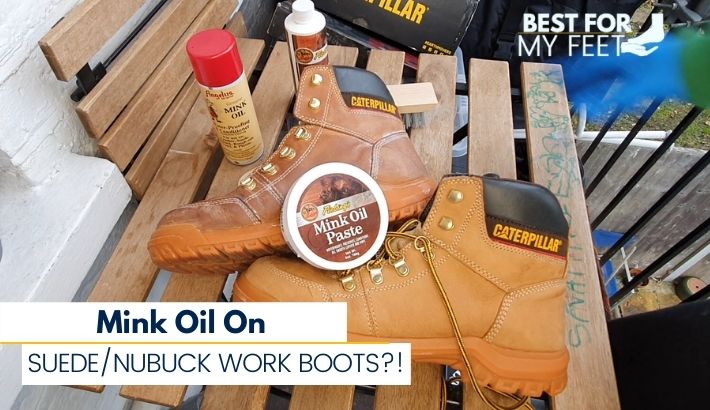
these are a few different types of mink oil products that have been used on my suede/nubuck leather work boots.

To help answer this question, I’ve used my own Caterpillar nubuck leather work boots to test this since most articles you’ll read online have no evidence of whether what they’re saying is true or not.

I did this so you don’t have to find out on your own work boots.

So…

Can you use mink oil on your suede and nubuck leather work boots?

If you’re here for a quick answer, let me tell you that mink oil WILL ruin your nubuck/suede work boots DEPENDING on which solution you’re hoping to use.

I’ll explain a bit more below.

Mink oil solutions I’ve used for this test

I always have some kind of leather conditioner at home since I need it to oil my construction safety work boots. So I didn’t buy anything new for this but used what I had at home:

What were the results?

Here’s what happened to my work boots using each one of the above-mentioned mink oil solutions.

Mink oil paste

my suede/nubuck leather work boots after applying mink oil paste to condition the leater.

This is the mink oil product you should avoid if you don’t want to damage your suede/nubuck work boots. This is quite a thick product and when applied to the leather it will form something like an additional layer on top of the leather.

This paste will cover all the suede and nubuck fibers and will ruin the esthetics of the leather by creating a shiny layer on top of the leather, more like a wax.

Now, this could be a good thing or a bad thing depending on what’s your goal.

If you’re like me and you have to work many times in the rain or wet conditions, using this paste will make the boot very watertight, almost waterproof for a few weeks.

But if you care about the aspect of the boot, this is the worse product you can use to oil your nubuck/suede work boots.

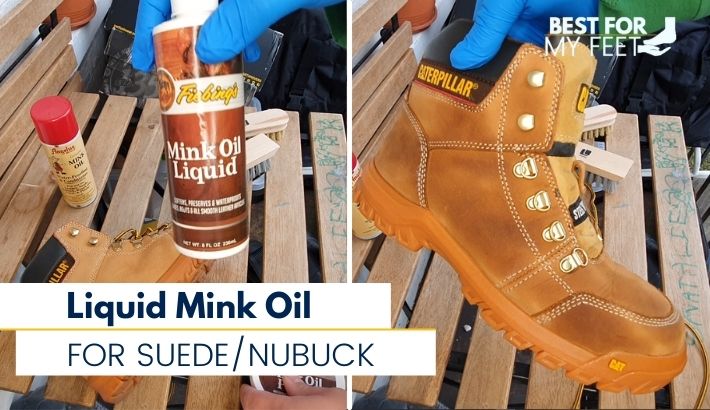
Mink oil liquid

a bottle of mink oil I've used to oil and condition my suede/nubuck leather work boots.

This solution is a bit better than the mink oil paste. If you’re careful when it comes to applying the oil to the leather, this will work just fine. Don’t soak the leather in mink oil though.

It won’t damage the leather since the oil acts as a conditioner but you won’t achieve what you’re looking for.

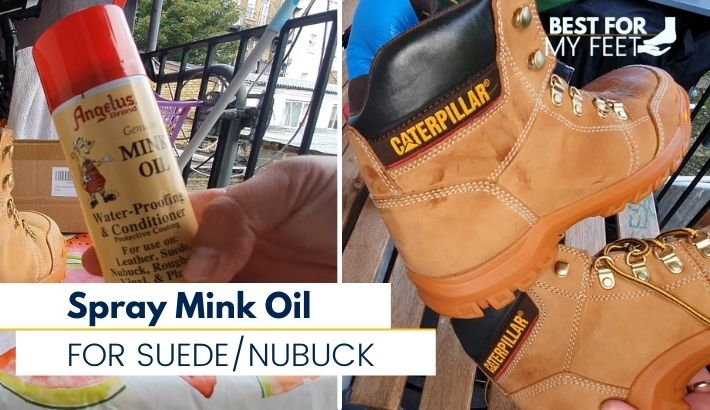
Mink oil spray

using a mink oil spray solution to condition my nubuck/suede leather work boots.

In my experience, this is the best solution for oiling nubuck and suede leather work boots.

The oil is spread out much better than if it was applied with a sponge, as you’ll do with the liquid mink oil, and in a much more controlled manner.

This avoids soaking the leather in mink oil and thus maintaining the nice patterns of your suede/nubuck leather.

Also as you can see from the image above, the oil is almost invisible as opposed to the other two solutions. The leather received and absorbed the oil much faster and it dries very fast leaving no signs as is getting dry.

Pros of cons of oiling your nubuck leather work boots

As you can see depending on which mink oil solution you’re going to use you’re going to achieve different results.

Some are better than others depending on what you’re trying to achieve. Here are a couple of good reasons you’d like to apply mink oil to your work boots.

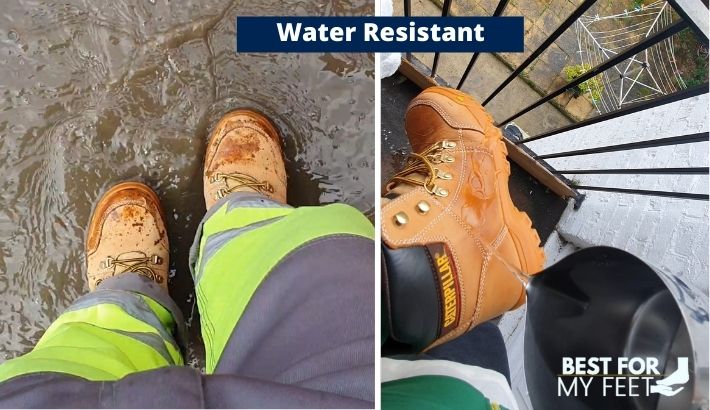
Resistant to water

walking with my suede/nubuck leather work boots through water after applying mink oil.

The leather becomes water repellent (not waterproof). But it will repel water if you’re working in the rain, wet grass, or wet environment in general.

This should keep your feet dry for a few hours whilst you’re doing your work.

Avoid cracks

With time leather becomes dry and when it is dry it becomes prone to cracks. This is one of the reasons most people have to replace their work boots prematurely. Using mink oil to moisturize and condition the leather will expand the life of your work boots and last longer.

On the other hand, consider the following before using mink oil on suede/nubuck leather.

Ruin the leather pattern

What makes suede and nubuck leather different than other types of leather (at least esthetically speaking) is the smoothness and the patterns that you can see on the leather as you slide your hand on it.

Well, once you apply mink oil, that smoothness might be gone depending on what mink oil solution you use and how much you apply as we’ve seen above.

So be careful and do more research before you apply mink oil to your boots.

the before and after results of applying mink oil to suede and nubuck leather work boots.

When should you oil your nubuck/suede work boots?

Personally, I oil my work boots every month, especially in the rainy season. That’s because I want my nubuck leather work boots to remain waterproof or at least water-resistant during those wet rainy days.

Also, don’t wait for cracks to show before you apply a little mink oil to your boots.

That usually means it’s too late. The leather has been damaged and you’ll have to visit a work boots store for a new pair. To avoid that, simply create a little routine where you can dedicate 1 hour per month to oil your work boots.

I know many of us don’t have for this but doing this will allow your boot to protect you better for longer. And save some money too by not throwing your work boots prematurely.

How often should you apply oil to your suede/nubuck work boots?

It’s up to you really and it largely depends on how much use and abuse you give to your boots and what’s the purpose of oiling them.

If you work in a warehouse or a retail store you might be ok to oil the boots every 3 months or so but if you’re in construction or similar you should look into doing it more often than that.

I am a construction worker and I oil my boots once per month just for pure maintenance. Once every 2-3 months or so I apply mink oil paste because makes the boots water-resistant and I like to work with my feet dry.

The takeaway

The main thing to take away from this article is that depending on what you want to achieve by applying mink oil to your suede or nubuck work boots, you’ll have to choose one or the other.

Using the wrong product for the wrong purpose WILL RUIN your nubuck/ suede work boots.

  • Do you want to restore your suede/nubuck leather on your work boots?

Then use the SPRAY MINK OIL.

  • Do you want to make your nubuck/suede work boots water resistant?

In that case, go for the PASTE MINK OIL.


Team Members Working On This Page

Victor Adrian – Editor And Webmaster

Construction Professional, driver, crane operator, cleaner, head chef … these are just some of the jobs I did in the past. Working in all these different environments taught me that having good footwear to protect your feet from different dangers at work IS PARAMOUNT for any worker! On this website, I aim to share all my knowledge and personal experience in dealing with different footwear and foot care issues, and hopefully, you can get something out of it. Enjoy!

Jessica Flynn
Jessica Flynn – Writer And Researcher

Love technology, going to the beach, taking care of my body, and writing (amongst other things). You’ll see my face around here a little bit since I’m responsible for part of the research and writing of some of the articles you’re reading on BestForMyFeet.com. I hope you’ll find our content helpful and enjoyable! See you around, thanks for reading!


source https://bestformyfeet.com/can-you-put-mink-oil-on-nubuck-and-suede-work-boots/

Thursday, 9 December 2021

Can You Wear Ankles Socks With Work Boots? (Good Or Bad Idea?)

Yes, you can wear ankles socks with work boots…but should you? That’s the question.

I mean, I get the appeal especially when you’re working on the hot summer days. Less fabric around your ankles will give you a fresher, breezier feeling…

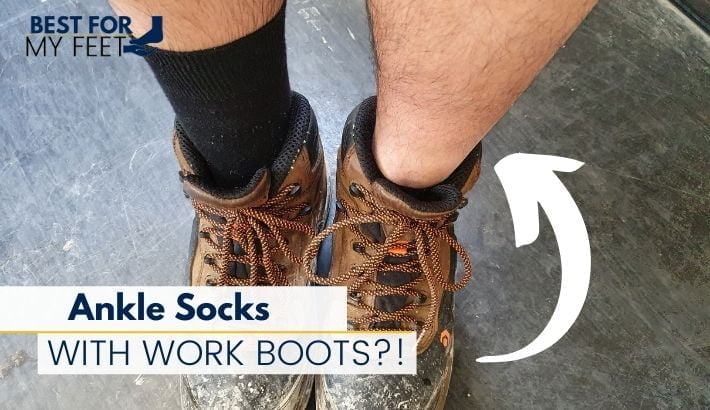
myself wearing a pair of crew work socks and one ankle sock with my work boots

But have you thought about comfortability?

Most work boots have an interior lining that’s made out of leather or some kind of textile. Find out what’s inside a pair of Timberland work boots here.

Can you imagine your ankles rubbing against that lining with every step you take or every bend and flex you make?

That’s a horrible thing to deal with for long shifts like the ones that I do which are no shorter than 10 hours per day.

You can definitely wear ankle socks with sneakers and shoes but personally, I still prefer to put on some crew work socks even when is burning hot outdoors.

You’re more vulnerable wearing ankle socks

It depends on what type of work you’re doing and what hazards you’re exposed to.

But for a construction worker, such as myself, is better to wear taller socks rather than ankle socks because you’re more protected against chemicals, sparks from welding, rashes from working with insulation, scratches if you’re doing gardening or landscaping, etc.

So by wearing ankle socks you’re leaving your lower legs exposed to injuries and that can easily be avoided by wearing crew socks or similar.

But, Adrian, is way too hot man, is there any alternative?

One alternative is to wear breathable work boots like these ones made by KEEN and instead of ankle socks, you wear a good pair of calf-high cotton socks.

The textile panels on these boots allow air to go in and out of the boot and have better air circulation overall. These will prevent your feet from sweating as much as in other boots and also help avoid your work boots stinking at cat pee.

The takeaway

I don’t recommend using ankle socks when wearing work boots. You’ll probably be fine if you’re wearing sneakers whilst working on a roof but not with work boots.


Team Members Working On This Page

Victor Adrian – Editor And Webmaster

Construction Professional, driver, crane operator, cleaner, head chef … these are just some of the jobs I did in the past. Working in all these different environments taught me that having good footwear to protect your feet from different dangers at work IS PARAMOUNT for any worker! On this website, I aim to share all my knowledge and personal experience in dealing with different footwear and foot care issues, and hopefully, you can get something out of it. Enjoy!

Jessica Flynn
Jessica Flynn – Writer And Researcher

Love technology, going to the beach, taking care of my body, and writing (amongst other things). You’ll see my face around here a little bit since I’m responsible for part of the research and writing of some of the articles you’re reading on BestForMyFeet.com. I hope you’ll find our content helpful and enjoyable! See you around, thanks for reading!


source https://bestformyfeet.com/can-you-wear-ankles-socks-with-work-boots/

Sunday, 5 December 2021

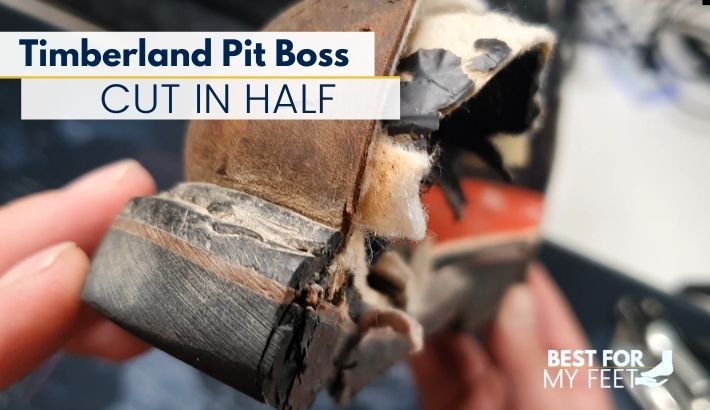
Timberland Pit Boss Work Boots Cut In Half: Here's What's In Them

Work Boot Anatomy: What’s Inside The Timberland Pit Boss Safety Boot?

Many times you can’t get all the information you need related to a work boot you’re about to buy. Sometimes you buy what seems to be a great work boot for your feet and for your specific environments and safety requirements…

…only to find out the boots weren’t as described in the product description!

That’s annoying!

cutting in half my Timberland pit boss steel toe cap boots to see what's inside and how are they made.

So by cutting my own work boots in half, I hope we can learn together more about how work boots are made, the materials used to make boots, what makes a good and comfortable work boot, and much more.

About the boot

Brand Timberland PRO
Model Pit Boss
Shaft height 6-inch from that arch
Heel height 1.5 inch
Color Brown
Toe cap Steel toe box
Upper Leather
Sole construction Goodyear welt
Price Goes for around $100-$150 depending on where you’re buying

How the boot was used

I’ve used these boots for construction work most of the time either operating plant equipment or doing light work on site. So I wasn’t walking as much as a site manager or putting them through a lot of punishment as many of you might do.

How long it lasted

I’ve had the boots for about 18 months before I’ve decided to retire them. The sole gave up on me at the heel and water was coming through. It was time for a new pair of work boots. I went with the Caterpillar Outline steel toe cap boot if you’re curious what was my choice.

Let’s start with the sole of the Pit Boss

the outsole of my Timberland Pit Boss steel toe work boots.

1. The outsole

If you go to Timberland’s website and read the product description you’ll see they say the sole is made of rubber. It’s a heat-resistant, durable rubber compound that provides slip, oil, and abrasion-resistant.

Although after cutting my Pit Boss Timbs in half it seems like the way they’ve made the boot is by using a 5mm TPU (thermoplastic polyurethane) outsole that’s a bit harder and more durable than the normal rubber.

2. The midsole

On top of that 5mm TPU outsole, you have a 22mm thick PU midsole (at the heel) and around 6.5mm thick midsole on the rest of the boot. This material (PU) is softer than the TPU and is what actually provides comfort and cushioning in your heels. This helps reduce foot fatigue.

3. Goodyear welt

timberland pit boss goodyear welt

You can resole this boot since it’s Goodyear welt constructed. This will expand the lifespan of this boot assuming you’re taking good care of the upper.

Some boots out there will have a fake stitch around the outside of the boot making it look like a Goodyear welt but the stitches are for design purposes alone. So be careful!

4. The footbed

The footbed is a simple 2.5mm thick piece of PU and fiberboard that sits right under the insole.

5. Where’s shank?

Bro, where’s the shank?! That was my question as I was dissecting these awesome steel-toe boots. So I couldn’t find a shank in these Timberland boots because they don’t have one.

timberland pit boss shank

Instead, Timberland has used a Nylon Shock Diffusion Plate in their Pit Boss work boots. In all honesty, I couldn’t tell until I cut them in half. These boots are one of the most comfortable work boots I’ve ever had.

This plasticky plate does an awesome job when it comes to giving you support and torsional rigidity.

6. The insole

The insole doesn’t show in the image above but it’s a very cheaply made insert that you should change it ASAP for a better quality one.

7. The heel

If you’re wondering how tall these boots will make you, you will gain about 1.5 inches in height when you’re in these boots.

You should stick to flat soles if you have back or knee problems but these aren’t that bad since a 1.5-inch heel it’s not considered to be that high.

8. Arch support

If you have flat fleet or you suffer from plantar fasciitis having a boot with arch support is paramount for your commodity whilst being on your feet for 10 hours or more doing your job.

This Timberland PRO comes with very little arch support (not to say none). I recommend you to go for some arch support insoles to give you that extra support.

9. Puncture resistant

I couldn’t find anything inside this boot sole that can make it puncture-resistant. So if that’s super important for your line of work don’t go with these boots (or buy a Kevlar insole if you prefer).

Personally, after wearing these boots for almost 2 years on construction sites I never had something going through the sole (nails, screws, glass, you name it).

The upper of these Timbs Pit Boss

Timberland pro pit boss upper construction

1. Upper material

The upper of these Timberland PRO boots is made of full-grain leather that’s about 2.3mm thick which is quite a decent thickness in a work boot.

2. The lining

These boots have a breathable and moisture-wicking lining.

3. The counter

The counter is made of some kind of plasticky material. This helps the boot to maintain its shape making it more comfortable to wear for longer. Talking about comfort, I like that they’ve put the counter in between the lining and the leather upper.

Timberland pit boss heel counter

That way it won’t bother you when walking. Some boots have the counter on the inside and the stitching and the counter itself can quickly become very annoying (and even give you blisters).

4. Toe cap

Since we’re talking about the steel toe model, well guess what, this boot has a steel toe cap. Timberland has a soft-toe boot version of this boot as well so make sure you buy the correct one when you’re browsing online.

timberland pit boss steel toe cap

5. Waterproof

I don’t think the lining in this boot is what makes it waterproof. I couldn’t see a waterproof membrane or a sealer or something that could make this boot waterproof.

Personally, I didn’t have to walk too much through deep puddles of water or work a lot in rain and wet conditions but when I did, I didn’t get my feet wet.

At the end of my boot’s life, I started to get some water through the sole though, not the upper.

From the reading I’ve done I’ve learned that Timberland treats the leather to make it waterproof so maybe that’s the case with these boots as well. I’m not sure. I’ll update the post if I can confirm this.

6. The stiching lines

I know when a boot is made for heavy-duty purposes when I see triple or quadruple stitching. This helps to keep the different parts of the boot together when you’re putting the boots through the harshest environments.

These Timbs come with quadruple stitching so you can be sure these bad boys won’t break anytime soon.

7. Insulation

The Pit Boss is not an insulated work boot so it’s not the best one if you’re working in freezing conditions. You can make it work by putting on some good wool socks assuming you have enough room inside the boot to accommodate thicker socks.

8. Padding

There’s a lot of padding in this boot to make it comfier and avoid blisters thanks to the 15.5mm thick foam you can find in the collar and the tongue of this boot.

Last words

I hope cutting my Timberland work boots in half helped you in some way. It certainly helped me learn more about how boots are made and how are they structured.

Now I finally understood why these boots were some of the most comfortable I’ve ever had (even though they were also one of the heaviest 6″ boots I ever had).


Team Members Working On This Page

Victor Adrian – Editor And Webmaster

Construction Professional, driver, crane operator, cleaner, head chef … these are just some of the jobs I did in the past. Working in all these different environments taught me that having good footwear to protect your feet from different dangers at work IS PARAMOUNT for any worker! On this website, I aim to share all my knowledge and personal experience in dealing with different footwear and foot care issues, and hopefully, you can get something out of it. Enjoy!

Jessica Flynn
Jessica Flynn – Writer And Researcher

Love technology, going to the beach, taking care of my body, and writing (amongst other things). You’ll see my face around here a little bit since I’m responsible for part of the research and writing of some of the articles you’re reading on BestForMyFeet.com. I hope you’ll find our content helpful and enjoyable! See you around, thanks for reading!


source https://bestformyfeet.com/timberland-pit-boss-work-boots-cut-in-half/
Brunt Versus Thorogood work boots: Here’s What You Need To Know

With Brunt Footwear gaining more and more traction, some of you looking into buying a new pair of work wanted to know how these two brands c...