Saturday, 4 March 2023

Avenger A7505 work boots cut in half: Here’s what’s inside these boots

Today we’re cutting in half one of my slip-on work boots, the Avenger Romeo A7505 wedge sole work boot.

This is not a review though, I’ll just talk about the materials you can find in these boots and also some things related to the construction of the boot. If you want to know more about the boot, you can read the full in-depth review of the Avenger A7505 work boots here.

About the boot

Brand Avenger
Model A7505 Wedge
Shaft height 6″
Color Brown
Toe cap Composite toe cap
Upper Leather
Sole type Wedge sole
Price Check on Amazon

The environment in which the boots were worn

If you don’t know me, I’m Adrian nice to meet you. I work in the construction industry and I also test and document my findings here on this website about everything I learn related to footwear and foot care.

So the boots were tested on a building site. The site I was working on whilst I was wearing these boots was a mix of unpolished concrete surfaces, tarmac, occasionally walking on rebar, and wet concrete.

How long the boots lasted?

This is one of the aspects I can’t comment on since I don’t wear the majority of the boots until they break. I usually wear them for 6 months to a year and if they don’t break, I just go ahead and cut them in half.

This will allow me to learn more about the boot and move on and buy another boot and do more testing.

If I had to give you an estimate based on my experience wearing these boots on a construction site, I’d say they will last around 14-18 months before they break.

Remember, this is an estimate, and the boots might last longer if you work in a lighter-duty industry than construction.

Let’s start with the soles of these Avenger work boots

1. The outsole

The outsoles on these Avenger A7505 work boots are made out of PU (polyurethane). This type of material can be very flexible and provide lots of cushioning depending on the hardness of the material.

In this case, the soles on these Avenger boots are quite spongy and lightweight which is great news for those of you working on hard concrete floors all day.

These types of outsoles help reduce the stress on your ankles, knees, and back by absorbing the shocks caused by the action of walking. So if you’re on your feet all day working in a warehouse or maybe in a factory, a welding shop, etc, these Avenger boots might be for you.

Personally, I would’ve liked to see a bit more arch support in these boots.

They might be great for you if you need work boots for a flat-footed person, but if you’re like me and have regular arches or high arches, you will need some over-the-counter insoles in order to avoid arch and heel ache after a long day in these boots.

I’ve worn a few insoles with these boots, one is the SOLE Active insole and the other one is the EcoDasher (which is a prototype so I can’t say much about it at the moment).

I’ll leave some measurements below in case they might help you in any way...

What was measured Data
Outsole thickness at the heel ~ 0.87″ (22.3mm)
Outsole thickness at the ball of the foot ~ 0.43″ (11mm)
Thread depth ~ 0.10″ (2.5mm)
Arch height ~ 1.07″ (27.2mm)
Outsole width at the ball of the foot ~ 4.70″ (119.4mm)
Outsole width at the heel area ~ 3.40″ (86.5mm)
Outsole width at the arch area ~ 3.48″ (88.5mm)

They have decided to stick a piece of rubber with the Avenger logo inside the outsole. Yes, it looks good, but I believe this can quickly become a liability if the logo piece somehow comes out while you’re working.

Especially if you work in an industry like mine. This could lead to sharp objects puncturing that specific part of the sole and eventually your foot.

I didn’t have any issues with that and I wasn’t aware of the little piece with the logo on it until I cut the boots in half. So it’s not a big deal, just an observation!

2. The midsole

The midsole in these Avenger work boots is a 9mm thick layer of polyurethane foam. The PU material found in the midsole is even softer than the one in the outsole.

This makes sense. The outsole has to be a bit tougher in order to last longer but the midsole, even though it’s made from the same material, PU, it’s softer so it can provide cushioning.

Here are a few measurements that might be helpful to you

Part being measured Data
Thickness – heel area ~ 0.35″ (9mm)
Thickness – arch area ~ 0.35″ (9mm)
Thickness – forefoot area ~ 0.35″ (9mm)

Yes, the measurements are not wrong. The thickness of the midsoles is the same throughout the length of the boot.

3. Insole

The boots come with a removable insole which is always great since each one of us needs something different when it comes to insoles.

So if you don’t like the one that comes with this boot, you can simply remove it and replace it with whatever you need or like.

The reason I swapped the original insole with something I had around is that the original insole doesn’t have that much arch support.

You can see in the image above how my insoles on the left (the PowerStep Original insoles) have a higher arch support than the Avenger’s insole.

I took a few measurements of the insole that might be helpful to you…

Part being measured Data
Heel area ~ 0.42 inches thick (10.8mm)
Forefoot area ~ 0.21 inches thick (5.5mm)
Arch height ~ 0.83 inches high (21.3mm)
Width – Heel area ~2.78 inches wide (70.8mm)
Width – Arch area ~3.22 inches wide (81.9mm)
Width – Foot ball area ~3.84 inches wide (97.5mm)

4. Boot construction type

Flex Welt Construction. This is another thing that might get you confused.

Just because it has the word “WELT” in the description and the boot has what seems to be a Goodyear welt construction, it doesn’t really make it a Goodyear welted work boot.

I thought the boot had a Goodyear welt as well, but as I cut the boot in half I realized that the upper is actually glued and tucked under the fiberboard.

As you can see in the image below, as I’m trying to take out the welt, I’m actually tearing apart the midsole. So the fake welt in these is in reality the midsole if it makes sense.

No drama, as some YouTubers and influencers tend to make out of this thing. You’re not going to resole a cheap pair of work boots anyway. A resole will cost you just as much as buying a new pair of the same work boots.

But I do agree that sellers should not try to trick consumers. Just say these work boots are cemented sole constructed and the Goodyear welt is for decoration purposes.

In any case, the glue was strong enough and kept the upper and sole together while I had the boots. No issues with sole delamination or anything related to glued-sole constructed boots.

5. Does it have a shank?

Yes, it does come with a shank, even though it’s not really required on these types of work boots. And I’m referring to wedge sole work boots.

The shank is more helpful when wearing heeled work boots. It adds extra stability and support in the arch area.

But if you’re wearing wedge sole work boots for your day job and you’re hitting the shovel all day, a shank is always welcomed!

According to most of the sellers carrying these Avenger boots, the shank is made out of fiberglass but it seems to me that it’s made out of TPU or some type of plastic.

It didn’t make any difference to me in all honesty but as I said there will be jobs and tasks where a shank in a wedge sole boot is going to be a blessing.

Here are some measurements of the shank if you want to geek out a bit more.

Part being measured Data
Shank thickness ~ 0.08 inches thick (2.1mm)
Shank length ~ 4.14 inches long (105.2mm)
Shank width ~ 0.58 inches wide (14.9mm)
Shank weight ~4 grams

6. Heel

I know some of you might be interested to know a bit more about the heel height so I took a few measurements in the hope that they might be helpful to you in any way…

Part being measured Data
Just the heel (outsole + midsole) 1.21 inches high (30.9mm)
Heel & footbed (outsole + midsole +fiberboard) 1.39 inches high (35.5mm)
Heel & footbed & insole 1.87 inches high (47.5mm)

7. Arch support

As mentioned in the outsole section, these Avenger work boots provide little to no arch support.

Great for those of you with flat feet or low arches but not that great if you’re like me and have regular arches or even high arches. You’ll need to add your own solution in order ro provide more arch support.

8. Puncture resistant

It seems there is some Lenzi Fabric in these boots (at least that’s why I’ve seen by looking at some seller’s product description) that make them puncture resistant, but I could not find it, not in the midsole, not in the lining, not in the insole.

There is a 0.11″ (2.8mm) thick hard fiberboard that sits right under the lining that was quite hard to penetrate when I tested it, but it’s not rated as such so you should not get these boots if you’re after puncture resistant rated work boots.

The upper of the Avenger A7505 work boot

1. The material of the upper

The upper of these Avenger work boots are made with full-grain leather. And if you’re wondering how thick that leather is, well let me tell you that’s 2.3mm thick.

Ideally, work boots should have thicker leather, 2.5mm or more but 2.3 is quite close. Not too bad for a boot in this price range.

Even though I had the boots for less than 12 months, the leather held up very well in my opinion. No damages or cracks whatsoever.

I did however take care of them, as I always do. I use mink oil to condition the leather and also to keep the boots waterproof.

Good leather in my opinion.

2. Lining

These Avenger Romeo work boots do come with a waterproof membrane that serves as a lining too.

When I did the waterproof test the boots were completely dry inside as long as the water stayed below the elastic gore panels.

If the water was deeper than that, wet socks straight away! 100%

What I find out after cutting the work boots in half is that the waterproof membrane got punctured where my pinky toe rubs against the membrane. So now, I can say bye-bye to the waterproof functions of these boots.

It’s not the first this happens to my waterproof work boots, so I might have to take some action moving forward in order to avoid this from happening.

Another thing I wanted to add is that the lack of a heel counter simply destroyed the waterproof lining at the back of my heel.

Actually, there is a heel counter in these boots and it’s made out of some plasticky material, maybe just a reinforced fiberboard but this heel counter sits behind the waterproof membrane.

So it’s not very helpful when it comes to protecting the waterproof membrane from getting damaged.

3. Toe cap

There’s not much to say here about this other than the fact that these Avenger boots come with a safety toe cap so if you work in construction or any other industry that requires a composite toe cap work boot then these are a good option.

If you’re new to work boots, you might want to know that the composite toe cap is much thicker, therefore bulkier. That’s the reason why you’ll see some composite toe work boots look quite bulky compared to steel toe boots.

Here are some measurements I took about the toe cap in case you want to know more…

Part being measured Data
Toe cap width (at the entrance) ~ 3.76 inches wide (95.5mm)
Depth ~ 3.48 inches deep (88.5mm)
Height ~ 1.44 inches high (36.6mm)
Thickness ~ 0.36 inches thick (9.1mm)

4. Anti-scuff cap reinforcement

This is a good feature in a work boot. Especially for those of you that need to crawl, crouch or kneel a lot.

Think of electricians, plumbers, mechanics, etc. I personally use the toe cap to rest materials whilst we’re getting ready for a particular task.

For example, when I was working with the glazing crew I would often rest a piece of glass on my toe cap while the boys were getting ready to install the glass.

One thing I was curious about was if there’s leather going under this bump cap or if the leather ends exactly where the bump cap starts.

Now that I’ve cut in half these Avenger boots I can tell you the leather stops where the bump starts.

I have no idea why they chose not to put leather under the bump cap as well. Having leather all the way through will definitely extend the boot’s life even more.

To me just having the TPU bumper will help for sure since TPU is harder to scratch and damage than leather. But if the bumper gets damaged, there’s nothing under that bumper to keep the boot watertight.

If you’d have leather all the way through, you’ll have to put these boots through a lot of heavy-duty work to damage the TPU bumper AND the leather.

My 2 cents anyway…

4. TPU heel guard

Just like the toe cap bumper, the help guard helps protect the boots from getting damaged when you kick things around with your boots. It’s also very helpful for taking the boots off.

There’s nothing much to add here other than the thickness of the heel guard which is 0.12″ (3mm) thick.

5. Insulation

These are not insulated work boots. The lining plus some good pair of Merino wool socks will help keep your feet nice and warm in chilled temperatures.

But if you’re working in freezing conditions, you better look at some winter work boots as these Avenger boots are not going to make the cut,

6. The gore panels

Good quality gore panels. They are elastic enough to put your feet in easily but at the same time strong enough to withstand hard work conditions.

During the time I had the boots I haven’t experienced any issues with the elastic panels.

Last words

There you have it, I’ve cut my Avenger Romeo work boots in half so we can all learn more about these boots.

Personally, I think the boots are not bad at all for the price. Decent boot construction and some good materials in there with the exception of the waterproof membrane.

I loved these boots for how comfortable and convenient they are. At the time I’m writing these lines I’m driving an electric scooter to and from work. And due to cold conditions, I’m wearing some overalls.

I miss the boots already as now I’m testing a pair of the NEW Brunt Marin work boots and these are lace-up vs. slip-on.

So now I need to bend and tie my laces!!! Spring is near so we’ll get rid of the overalls soon.

Anyway, that’s all from me.I hope this was helpful to you in any way. Let me know if you have any questions!


Team Members Working On This Page

Victor Adrian – Editor And Webmaster

Construction Professional, driver, crane operator, cleaner, head chef … these are just some of the jobs I did in the past. Working in all these different environments taught me that having good footwear to protect your feet from different dangers at work IS PARAMOUNT for any worker! On this website, I aim to share all my knowledge and personal experience in dealing with different footwear and foot care issues, and hopefully, you can get something out of it. Enjoy!

Jessica Flynn
Jessica Flynn – Writer And Researcher

Love technology, going to the beach, taking care of my body, and writing (amongst other things). You’ll see my face around here a little bit since I’m responsible for part of the research and writing of some of the articles you’re reading on BestForMyFeet.com. I hope you’ll find our content helpful and enjoyable! See you around, thanks for reading!


source https://bestformyfeet.com/avenger-a7505-work-boot-cut-in-half/

Sunday, 26 February 2023

Irish Setter Ashby Versus Wingshooter ST Work Boots (Learn All The Differences)

Have you ever found yourself looking at a brand’s website trying to figure out which one of their boots will work best for you? If so, you’re in luck!

Here at BestForMyFeet.com we have spent countless hours testing and wearing boots in actual real-world work conditions to help you make the best decision possible in your work boot hunt.

Today we’ll be looking at Irish Setter by Red Wing and comparing their two most popular work boots, the Ashby versus the Wingshooter ST. Both boots are the safety toe versions.

The work environment I’ve been wearing these boots in is a sheet metal fabrication and welding shop. Yes, I do actual work in my work boots! I’m not just a reviewer, I also fabricate and weld by day. Ok, that’s enough about me. Let’s get into this comparison!

Who’s working on this page

Adam Rich, author and product reviewer at bestformyfeet.com
Adam Rich
Author & Researcher
Victor Adrian
Researcher & Editor

By the way, if you want to learn more about each one of the boots individually, we have very in-depth reviews of both boots and you can find them here:

Ashby vs Wingshooter: Safety features

The Ashby and Wingshooter ST both share similar safety features that are standard for work boots and required on many a job sites.

1. Safety toe box

As I said in the intro, both work boots come with a safety toe cap. But there is a difference when it comes to what type of material the safety toe cap is made from.

The Ashby has an aluminum alloy safety toe that is ASTM F2413-18, M/I/C, EH compliant.

Whereas the Wingshooter ST features a composite safety toe that is also ASTM F2413-18, M/I/C, EH compliant.

Both must be able to maintain 0.5 inches of clearance when subjected to an impact with the force of 75lbs and 2500lbs of compression. Both meet this requirement.

2. Slip resistant

Both the Ashby and Wingshooter ST are “ASTM F3445-21, SR” compliant for slip resistance.

I could not tell if there was any difference between the two in terms of how much they grip the floor. They seem pretty much the same.

Both work boots were quite good for my environment, which again, I’m working mostly indoors, on hard, smooth concrete floors.

3. Electric hazard

Both the Ashby and the WingShooter are ASTM F2413-18, M/I/C, EH compliant for electrical hazards.

Meaning both boots must be made with non-conductive outsoles capable of withstanding 18,000 volts at 60hz for one minute with no current flow in dry conditions.

Both work boots can be a great boot option for an electrician.

Especially the Wingshooter since not only comes with a wedge sole but also there’s a heel option available. Much better for those of you that need to stand on ladders.

Ashby vs Wingshooter: Leather

If we were creating a winner and loser in this comparison, the Ashby work boot would hands down win this category.

The Irish Setter Ashby features Trout Brook leather, which is named after the brook that flows behind the tannery.

This just isn’t any tannery either! It’s the S.B. Foot Company tannery that makes the leather for the Red Wing heritage line.

The Ashby definitely has some nice leather. But with that nice soft leather, it seems to be more prone to scratches and gouges.

The Irish Setter WingShooter ST doesn’t have as nice of leather. It almost feels plastic-like feel to me but rest assured it is full-grain leather.

Let’s be real though, we shouldn’t be basing our work boot decisions solely on the leather alone.

I will tell you that the Wingshooter ST leather definitely seems like it is more scratch resistant than the Ashby leather. I have slits and gouges on the Ashby’s toe that I don’t have on the Wingshooter toe.

Wingshooter vs Ashby: Outsole

Both the Wingshooter ST and the Ashby work boots feature the exact same outsole. It’s a rubber EVA traction tread outsole.

This means that glued to the midsole is an EVA outsole that has a thin rubber traction tread glued to it.

This type of outsole combines the best of both worlds.

It gives you the resilience of a rubber outsole while also the soft cushion of an EVA outsole. The outsole is also stitched to the welt around the toes for added durability.

The outsole is also heat resistant up to 475°F, and as we previously mentioned both are slip-resistant work boots (again, in MY environment).

Ashby vs Wingshooter: Boot Construction

Both boots feature a Goodyear welted construction. Meaning they can be easily resoled by a cobbler.

The Ashby features a Storm Welt that is made of a PVC material. The downside to a synthetic welt is that they are prone to cracking meaning that a resole will be more expensive if the boot needs to be re-welted.

The Wingshooter ST however has a leather Goodyear welt. Leather welts are superior to synthetic, as the leather will last longer and the odds of a leather welt being too damaged to resole are slim.

Another thing that stands out on the Wingshooter work boot is the extra stitching on each side of the safety toe cap. The Ashby work boot does not have this.

I don’t know if they did this in order to increase durability in that area or what but it seems to me that it might actually be a weakness. So far so good though. The stitches are holding up very well.

Wingshooter vs Asbhy: Comfort

Let’s check out some of the most important features of these work boots when it comes to comfortability.

1. Footbed/Insole

Both the Ashby and the Wingshooter ST work boots feature a removable polyurethane footbed.

They are very similar and both are comfortable. Though I do think the Wingshooter ST is a little squishier.

2. Arch and ankle support

The Ashby has very good arch support built into the boot. It’s perfect for people like me with higher arches.

However, those with a low arch or flat feet may not like it. Ankle support on the Ashby is very average, not bad but not anything special either.

The Wingshooter on the other hand has a very flat arch by comparison. Great work boots for flat-footed people but if you have a higher arch you may need to replace the removable insole with an over-the-counter insole with arch support.

The ankle support on the Wingshooter is very good.

This is because of the padding around the top of the boot combined with the waterproof liner, which, acts almost like a thick padded sleeve around your ankle.

Additionally, if you have weak ankles or if you simply like even better ankle support, the Wingshooter comes in an 8in version too.

3. Boot weight

Both, the Winghsooter and the Ashby are extremely lightweight for a work boot. We all know the feeling of stomping around a job site all day or walking and standing all day in a pair of heavy boots.

The Ashby and the Wingshooter ST are both light enough to wear all day.

  • The Ashby comes in at 1lbs 13oz per boot.
  • The Wingshooter comes in at 1lbs 15oz per boot.

Please note that the sizes worn for the review are both 11.5D. So it’s possible for them to go up or down in weight depending on the size you buy.

4. Boot width and wiggle room

Both the Ashby and Wingshooter come in D(medium) and EE(wide) widths. Both should accommodate wide feet.

For example, I ordered a D width for both, but the Red Wing store has my feet as an E width, and they fit just right. Both are roomy in the toe box for a normal-width boot.

5. Boot tongue

The Ashby comes with a tongue that is not gusseted. It’s a lot like the tongue in an athletic shoe.

It makes it very easy to slide on compared to a boot with a tongue that has a high gusset like my Red Wing 877s.

The Wingshooter ST does have a gusseted tongue but it’s not so high that you have trouble sliding your foot into the boot. The gusset is also part of the waterproofing system in the WingShooter work boot.

Editor Note

Both, Adam and I prefer a gusseted tongue in a work boot, but for different reasons. He likes the gusseted because it can prevent water from coming into the boot even if the boot is not completely waterproof.

And I like the gusseted tongue because it stops it from moving around as a non-gusseted would and also stop debris from coming into my work boots.

Waterproofing

The Ashby is not waterproof by any means. When I did the waterproofing test my socks got soaked as soon as I placed the boots in the water pan.

The lack of a gusseted tongue offers very little water resistance. If you step into a deep puddle you’ll have a wet sock.

However, The WingShooter ST is waterproof and will keep your feet dry.

Which one gets hotter? The Ashby or the Wingshooter?

Personally, my feet are always sweaty in boots. I think the Ashby and Wingshooter ST work boots feel about the same.

I know on paper the Wingshooter ST should be the warmer boot because of the waterproof liner but I’m not feeling it. And despite having sweaty feet, my feet never feel hot in either boot.

Break in period

The Irish Setter Ashby definitely has a break-in period. I experienced heel slip for a few days until the leather broke in around my heel and ankle. I was able to minimize heel slip by using a heel lock lacing method.

The Irish Setter Wingshooter ST on the other hand didn’t really have a break-in period.

I think the waterproof liner helped prevent my heels from slipping too much. So I won’t say there was a break-in period but they did get more comfortable over the course of about five days, though, they never were uncomfortable.

Ashby vs Wingshotoer: Where are they made?

There is no difference between them here since both models are made overseas, more specifically in Vietnam.

Price: Asbhy vs Wingshooter ST

The Wingshooter ST is the more expensive work boot but both are reasonably priced. You can get the WingshooterST for as low as $189.99 on Amazon and the Ashby for as low as $147 on Amazon.

The Wingshooter definitely earns the $40 price difference with its leather welt and waterproofing system.

As we all know, prices do change so maybe the prices I’ve shared with you above might not be exactly the same depending on when you’re reading this comparison.

The best thing to do is to check the latest price on the different stores listed below that carry these work boots.

Irish Setter Ashby

Check The Latest Price

Irish Setter Wingshooter ST

Check The Latest Price

Pros & Cons of both work boots

In the tables below I’ll quickly summarize what I believe to be the pros and cons of each one of these work boots.

Good and bad of the Wingshooter ST boot

PROS CONS
Lightweight Very flat arch. May need to sink another $50+ into them for insoles with arch support. Not a con if you’re a flat-footed person though.
Leather welt The waterproof liner may cause some people’s feet to sweat excessively
Waterproof
Has speed hooks
Roomy toe box
Gusseted tongue

Good and bad of the Ashby boot

PROS CONS
Lightweight Little to no water resistance
Really nice US made leather upper Heel slippage during break in period
Moisture wicking lining around the forefoot Synthetic weltNo speed hooks for lacing
Roomy toe box
Great arch support out of the box
Gusseted tongue

Ashby vs Wingshooter models available

These are the Irish Setter Ashby work boots models you’ll find on the market:

Ashby 83606 (most popular model) – Safety Toe – Brown – Lace up See In-Store
Ashby 83652 – Safety Toe – Black – Lace up See in-Store
Ashby 83605 – Soft Toe – Brown – Lace up See In-Store
Asby 83908 – Safety Toe – Pull On See In-Store

And these are the Irish Setter Wingshooter boots model available in different online and local stores. I’ll abbreviate the word Wingshooter to WS because there’s not enough space in the table below.

WS-83632 (most popular model) – Safety Toe – Brown – 6″ Lace up – Wedge sole – Moc Toe See In-Store
WS-83620 – Comp Toe – Brown – 6″ Lace up – Heeled sole – Moc Toe See In-Store
WS-838: Soft Toe – Brown – 7″ Lace up- Heeled sole – Moc Toe See in-Store
WS-845: Soft Toe – Black – 7″ Lace up – Heeled sole – Moc Toe See In-Store
WS-807: Soft Toe – Brown – 7″ Lace up- Heeled black sole – Moc toe See In-Store
WS-83802: Comp Toe – Brown – 8″ Lace up – Heeled sole – Round Toe See In-Store
WS-83832: Comp Toe – Brown – 8″ Lace up – Wedge sole – Moc Toe See In-Store

To my surprise, there are a few extra models on Amazon that you can’t find on Irish Setter’s official website, but I choose not to link them in this post.

That’s because there’s a lot of confusion in regard to which models those are, what features they have, etc. Some Amazon sellers suck at their job.

Who do I recommend these boots to?

I recommend the Ashby and the Wingshooter ST to anyone looking for a high-quality boot at an affordable and reasonable price. Both boots have a lot of bang for your buck and the Ashby has the best leather of any boot under $200 hands down.

Since both work boots have a wedge sole I’d recommend both boots for those of you working on hard, flat concrete floors.

So they can be a great choice for people in the trades, commercial and residential.

These types of soles are perfect if you have to go in and out of people’s homes or offices all day since the outsoles don’t drag mud and dirt.

Also, these are great boots if you’re a warehouse operative, Many people ask in the work boots sub for a good work boot for warehouse workers, and well these are perfect candidates.

Other jobs and industries that come to mind:

  • Great choice for most people in the trades
  • Water plant operators
  • Mechanics
  • Construction site managers
  • Factory workers
  • and more…

My final thoughts on this Ashby vs Wingshooter work boots comparison

It is this reviewer’s opinion that both boots are solid choices but which one is best for you is going to be dependent on your work environment.

If you spend a lot of time working outdoors in the elements, on new construction sites, muddy, snowy, wet conditions and such, the Wingshooter ST will serve you well whereas the Ashby might have you hating life.

However, if you work in primarily dry conditions, such as in a shop environment, warehouse, mechanic, drywall, residential service tech, or any other trade that have you primarily inside then you may want to choose the Ashby.

Both boots will serve you well but I will say the Wingshooter can serve all the above-mentioned environments well.

I hope this comparison between the Irish Setter Ashby and the Wingshooter work boots has helped you and provided some insight into your decision.


Team Members Working On This Page

Adam Rich – Boots Tester & Reviewer

Hey, I’m Adam. I’m a welder and metal fabricator. Primarily doing aluminum tig and sheet metal fabrication. Spend most of the day on my feet on concrete floors in the shop with the occasional job site visit.

Victor Adrian – Editor And Webmaster

Construction Professional, driver, crane operator, cleaner, head chef … these are just some of the jobs I did in the past. Working in all these different environments taught me that having good footwear to protect your feet from different dangers at work IS PARAMOUNT for any worker! On this website, I aim to share all my knowledge and personal experience in dealing with different footwear and foot care issues, and hopefully, you can get something out of it. Enjoy!


source https://bestformyfeet.com/irish-setter-ashby-vs-wingshooter-work-boots/

Saturday, 25 February 2023

Where Work Boots Are Made? (31 Brands Checked: Find Yours Here)

Where are your boots made? It’s an important question to ask because you want to ensure that the quality and safety of your footwear are maintained. This blog post will discuss where work boots are manufactured and some tips on finding the best work boots deal possible!

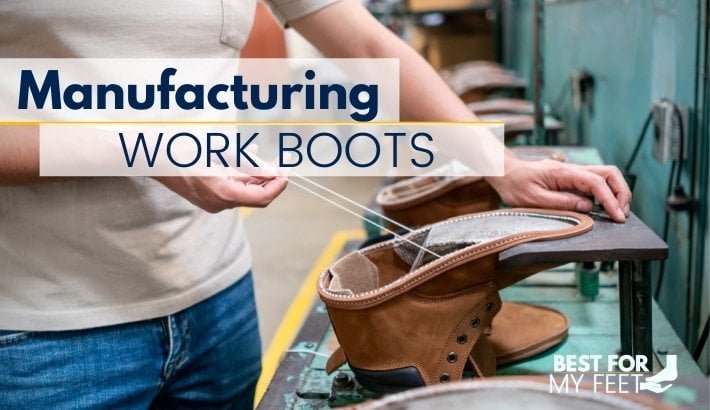
a worker in a work boot factory manufacturing a pair of work boots

Are your work boots made in the USA? It’s not a question to ask just any company! There are many overseas manufacturers who produce footwear for American companies.

You’ll want to look at where they’re manufactured, what materials and processes go into the manufacturing process, and how much of their production is exported before you make your purchase.

We’ll look at over thirty different work boot brands and ask if they manufacture their work boots in the USA or elsewhere, and the extent to which they do make USA boots.

1. Ariat

While Ariat has design facilities in the United States, their primary locations for manufacturing are in Italy, China and Mexico. 

According to reviews of the Ariat Workhog, these work boots are made in China and even though it seems to be a good work boot, there is disappointment among their customers that such products aren’t made in the USA given the premium price-point of the boot.  

2. Avenger

Their motto is ‘When the going gets tough, the tough wear Avenger.’ They’re marketing themselves as the all-American, tough-man’s brand. But where are Avenger work boots made? 

It’s disappointing that companies are often not more upfront with this information since it is very important for consumers to know which country’s economy they are supporting.

After an extensive amount of research, we found a Pinterest pin that indicates that at least one of the products in their women’s line, is made in China. 

Editor Note

I end up buying a pair of Avenger work boots for myself and the label on my Avenger work boots confirms what we knew already. That the Avenger work boots are made in China.

If you want to learn more about the work boots Adrian reviewed you can find his full review of the Avenger A7505 work boot here.

where avengers work boots are made

3. Brunt

While an American company that sells directly to American consumers, it is not entirely clear from their website or other sources where the boots are actually made. 

Brunt is a relatively new player in the space, only being founded in 2019 by Eric Girouard, and their specialism is comfortable boots that are long-lasting. 

With this in mind, Brunt workwear claimed in a recent social media post that their boots are manufactured in Jinjiang, China because the technology the boot uses ‘isn’t here in the US and can’t sacrifice comfort.

Their offices and warehouses are based in Maine, USA. 

That said, Brunt says once they become big enough they hope to open a factory in either New Hampshire or Maine. 

Editor Note

Update: Now that I have a pair of Brunt Marin work boots myself I can tell you that the label on my Brunt work boots states the boots are made in China.

4. Bata

Bata Industrials is a Dutch company and so a large number of Bata work boots are produced in Brabant, a province of the Netherlands. 

Some of their other gumboots are made in New Zealand, this is according to the New Zealand version of their website. 

5. Blacksmith

Blacksmith work boots are a division of Red Wing. Models such as the Men’s Six-Inch Boot in Copper Rough and Tough Leather are part of their Heritage Line which means they are manufactured exclusively in the United States of America. 

Customers who bought this product loved the fact it was made in the USA, as well as the excellent support it provides to aging and well-worn feet. 

6. Blundstone

Blundstone is an Australian company that predominantly manufactures its products in Vietnam, India, China, and Mexico. However, their gumboots are made in Hobart, Australia. 

Adrian had a pair of Blundstone work boots and according to the label on his boots, his Blundstones were made in Vietnam.

If you want to learn more about this work boot you can either read the:

7. Caterpillar

One model of Caterpillar work boots, the Liberty ST – Brown, is made in the USA. However, a recent Footwear Distributor and Retailers of America (FDRA) announcement implies this is their first all-American invention, implying that they do not manufacture their other products in the USA. 

However, they are committed to supplying chain transparency and corporate responsibility in their manufacturing protocols. 

One of the Caterpillar boots we had the chance to test and review is the Caterpillar Outline. According to the tiny letter on the label of this boot, the Outline model is made in Bangladesh.

where caterpillar work boots are made

If you want to learn more about this work boot you can either read the:

8. Carolina

While Carolina does not make all of their work boots in the United States, there are 33 different styles, that are specifically “Made in America,” at their Martinsburg Pennsylvania Factory.

Why is there such demand for made in USA work boots from Carolina?

They incorporate only the best globally sourced materials and components available, and in buying these boots you are supporting American jobs. 

They are also an approved vendor for the government of the United States of America. 

9. Cody James

Cody James work boots are made in China.

This should be obvious from the low price-point they offer their work boots at, as well as the cheap leather and construction materials they use. Check out this selection of the best cheap work boots if you’re looking for similar boots.

10. Carhartt

Much of Carhartt’s manufacturing takes place in Mexico however they have an extensive Made in the USA range, not just of work boots but also coats and other apparel. 

Carhartt has four factories in the United States of America, including one in Kentucky and one in Tennessee.

No brand in the world makes more rugged footwear in the United States than Carhartt. 

Looking for more from this brand? Check out this Carhartt work boots reviews article we’ve put together where we looked more in-depth at over 20 models and picked only the best ones.

11. Dewalt

As well as manufacturing high-quality power tools, including drills and laser levels, Dewalt has recently expanded into the work boots market. 

As with many of their other products, Dewalt work boots are predominantly made in China. They justify this by claiming it passes savings onto consumers.

Even though they’re made in China, boots like the DeWalt Newark are very comfortable.

where dewalt work boots are made.

If you want to learn more about this work boot you can either read the:

12. Double H

Double H work boots are made in Pennsylvania, USA from global components. 

Double H are a work boot brand footwear with state-of-the-art technology, safety, and comfort features. They think it is important to be consistently innovating in the space to ensure that workers are getting the best value. 

And this can be best done by manufacturing close to their corporate headquarters in Pennsylvania. 

13. Danner

A large number of Danner work boots are made in their Portland Oregon facility, though not all of them are. 

Though some of their manufacturing has moved overseas, Danner is still committed to using the highest quality craftsmanship in their products. 

14. Georgia

Nearly all of the manufacturing for Georgia work boots is based in Atlanta, Georgia, where it has been based since 1937. 

15. Irish setter

Another division of Red Wing, Irish Setter work boots are manufactured overseas, mostly in Vietnam at the time of writing this article and some others in Cambodia or China.

Irish Setter work boots are focused on ensuring you can keep going all day. When you’re working 12-14 hour shifts, all day on your feet, comfortability is key in a work boot.

Based on our tests and consumer reviews, the Irish Setter work boots might not be as durable as the Red Wing boots made in the US but the comfort is second to none.

And the best thing is, they’re cheaper than the Red Wings.

where Irish setter work boots are made.

We’ve done reviews on some of the Irish Setter work boots and you can find them here if you want to learn more about them:

16. Iron age

According to customer reviews of the Iron Age Men’s GroundBreaker work boot, this particular brand is made in China, which the users see as a drawback, albeit the only drawback for the owners of an otherwise excellently constructed work boot. 

17. Justin

Between 75-80% of Justin’s work boots are crafted overseas, with even their Cowboy work boots being manufactured in China. 

18. Kodiak

Part of Kodiak’s manufacturing operations have recently been relocated to Canada, a homecoming for the company, having ceased all operations in the country in 2000 before returning in 2006. 

Kodak was founded in Canada in 1910, and kept manufacturing in Berlin, Ontario throughout the Great Depression and WW2. 

Though the opening of a new plant in 2006 was huge news for the region, it should be noted much of their manufacturing currently still takes place overseas. 

19. Oliver

Oliver is one of those manufacturers of work boots based in Victoria, Australia. 

While they kept manufacturing in Australia for as long as possible, in 2018 it was announced they would be moving much of their manufacturing to East Asia to ‘drive greater efficiencies. 

20. Red Wing

All Heritage Red Wing Boots are manufactured in the USA by hand. These include makes such as the Moc Toe and the Chelsea Rancher. 

Other work boot lines such as the Irish Setter Boots, Vasque, and Worx are made overseas. 

Additionally, even some of the materials in the USA-made ‘Heritage line’ are sourced from Cambodia; so even there it is not an entirely ‘American made’ boot.  

21. Rocky

Rocky work boots are made in China, where the working conditions have been criticized by labor rights activists.

22. Rockrooster

Rockrooster work boots are also made in China. We can discern this from customer reviews on Amazon, one of the largest e-commerce websites in the world.

A few owners of ROCKROOSTER work boots (including our boots tested, Kobe) indicate that their boots are made in China (that’s what it says on the boot’s label).

23. Rossi

Rossi is an Australian company which has been manufacturing work boots in Australia since 1910. They now have a modern, well-equipped factory in Adelaide, South Australia where they combine tried and true blue craftsmanship with state of the art technology. 

They make Ripple Sole Desert and Mulga Boots in Australia, all other work boots are manufactured overseas. 

24. Redback

Another Australian based company, Redback work boots have been based in Australia since the early 1900s. All work boots are hand-made in Australia. 

So of the Australian companies in this roundup, if a commitment to domestic manufacturing is important to you, this is the company to go for. 

25. Reebok

While some Reebok work boots are manufactured overseas, they have an extensive range of work boots that are made in the USA. 

26. Skechers

Skechers are the third largest athletic footwear brand in the United States, however, and this they are less known for, they also make work boots. 

You can view their extensive range here

Skechers, for both their athletic footwear and work boots, utilizes, by their own admission, ‘many factories and suppliers in Asia’. 

The company remains committed to enforcing a supplier code of conduct to ensure the highest ethical standards in their foreign-sourced products. 

27. Steel blue

Steel Blue work boots are manufactured in Australia, though they also have manufacturing facilities in Indonesia. 

28. Terra

Though historically based in Canada, Terra work boots maintain an extensive overseas network of manufacturing.

That said, they are one of the few Canadian companies to still manufacture boots in the province.

29. Thorogood

Thorogood has an extensive range of USA-made, union made work boots including boots in the American Heritage, 1957 Series, and Logger lines, that are ideal for the working professional seeking to express solidarity with their fellow tradesmen. 

As with a lot of brands, this does not necessarily mean they are all made in the USA. 

Find out more about some of their best-rated model in this Thorogood work boots reviews article.

30. Timberland

Timberland boots are manufactured in three countries, the USA, China, and the Dominican Republic. 

You can find their extensive range of USA-made products here

However most of their products are made outside of the USA. 

31. Wolverine

Wolverine is another excellent brand for producing American-made work boots for the working professional. 

Their boots are produced right out of their plant in Michigan USA, as well as others around the continental United States.  Do you want to know more? Find out here if Wolverine work boots are any good.

What are the pros and cons of buying work boots in the US?

The most obvious pro is supporting American manufacturing and American workers, giving them more money to in turn buy goods and services from other American businesses.

Keeping American manufacturing domestic also boosts a sense of patriotism and community cohesion. 

It reduces carbon emissions by avoiding the emissions produced by international shipping. 

And it can result in a quicker turnaround if the delivery is just from an American factory to your door. 

The downside to buying work boots made in the USA is that you get less of a variety of materials, since companies who emphasise American manufacturing will source materials local to the Americas. 

And paying American manufacturers western wages does boost costs, sometimes, though not always, resulting in American-made work boots costing more. 

Which work boots last longer? (US-made or overseas?)

American-made work boots tend to last longer over time. American-made boots typically have higher quality, and they are usually patterned with more attention to detail.

They also tend to be built of better materials such as leathers from domestic cattle, tanned hides, and rubber soles. 

In general, they will last longer because less effort is made in potential damage due to lower-cost materials such as petroleum products for synthetic timber or low-quality tree bark for leather tanning. 

However, these advantages can also come at a higher price which might explain why some people prefer the cheaper price, which may suit those who purchase work boots that do not need to last for as long a time period. 

Conclusion

This blog has given you a quick overview of where some of the most popular work boots brands are made. 

Some companies are not as forthcoming with this information and so we had to do a bit of digging and work by inference. 

Some also split their manufacturing base across different countries, with some specific products of some brands being made in the USA and some not. 

In fact, very few brands are entirely made in the USA, but the ones which make more of an effort are Red Wing and Blacksmith. 


Team Members Working On This Page

Jessica Flynn
Jessica Flynn – Writer And Researcher

Love technology, going to the beach, take care of my body, and writing (amongst other things). You’ll see my face around here a little bit since I’m responsible for part of the research and writing of some of the articles you’re reading on BestForMyFeet.com. I hope you’ll find our content helpful and enjoyable! See you around, thanks for reading!

Adrian – Editor / Construction Professional

Construction Professional, driver, crane operator, cleaner, head chef … these are just some of the jobs I did in the past. Working in all these different environments taught me that having good footwear to protect your feet from different dangers at work IS PARAMOUNT for any worker! On this website, I aim to share all my knowledge and personal experience in dealing with different footwear and foot care issues, and hopefully, you can get something out of it. Enjoy!

Theo Cox / Researcher, Writer

I’m an MA student currently working on a research project for King’s College London Museum of Life Sciences alongside my MA dissertation. I have been published in my student newspaper, The Spectator, and the Adam Smith Institute. I’m doing part of the research and writing of the content you’ll read on BestForMyFeet.com Enjoy!


source https://bestformyfeet.com/where-work-boots-are-made/

Brunt Versus Thorogood work boots: Here’s What You Need To Know

With Brunt Footwear gaining more and more traction, some of you looking into buying a new pair of work wanted to know how these two brands c...