Monday, 12 September 2022

How To Apply Mink Oil To Work Boots (3 Different Mink Oil Solutions)

If you have a good pair of leather work boots you must take care of them if you want them to last longer. It’s not only that, but I like to look sharp at work. Yes even when wearing work boots.

Some people (especially men) roll their eyes when I talk about the looks of my work boots but in my opinion and personal experience, the better you look, the more professional you’ll come across and people will trust you more.

That’s my experience anyway. So today I’ll share with you how I use mink oil on my work boots in order to expand their lifespan and also to keep them in a good-looking shape.

Spoiler: it’s not rocket science as some people might make it sound.

But first, let’s talk about safety and if mink oil is a good product to use on leather work boots or not…

Should you use mink oil on your work boots? (is it safe?)

I never had problems using mink oil on my work boots with one exception.

One day I was testing to see if mink oil will ruin suede/nubuck leather and that’s how I find out that it wasn’t a good idea to use mink oil paste on that type of leather. It will completely ruin it.

Other than that, I’ve used mink oil on all types of leather work boots and I can’t say based on my own experience that the mink oil damaged the leather or compromised in any way the upper of my work boots.

Which mink oil solution should you use?

showing how am I applying the different mink oil solutions to my work boots

What do you mean?” you might say. “How many mink oil solutions are out there?

Well, basically there are 3 mink oil variations out there. It’s the same product but in different forms:

  • Mink oil liquid (the most common one)
  • Mink oil paste (thick, solid form of mink oil)
  • Mink oil spray (best solution for sensitive leathers like suede)

Before you apply mink oil to your work boots

If you’ve never applied mink oil to your work boots you might not know this but mink oil darkens the leather. The clearer the leather of your work boot is, the more you’ll see the difference.

So this is a downside of applying mink oil to light leather work boots. Here’s what it did to my Thorogood American Heritage moc toe boots.

showing how dark my leather work boots are now after applying mink oil to them.

To me personally, it doesn’t make that much of a difference since I work in construction and my boots do get dirty a lot.

Darkening of the leather is the least of my worries but if you work in a warehouse or maybe in the retail space, or maybe you are a manager then I bet this is something you might want to consider before applying mink oil to your work boots.

Alright, now that this is out of the way, here’s how I apply mink oil to my work boots.

What you’ll need in order to apply mink oil to work boots?

showing the products I use when I apply mink oil to my work boots

I’m sure you have some of these things at home but here’s what I use for this process:

  • Nylon brush to clean the boots from concrete, mud, and other debris
  • Horsehair brush to spread the mink oil
  • Some cloth or an old t-shirt to apply the mink oil
  • Mink oil solution (spray, liquid, paste)

Applying the different mink oil solutions to work boots

The first step is to clean your work boots. I don’t go all in with the cleaning. Not all the time anyway.

I like to clean my work boots with saddle soap every 3-4 months to bring them back to life.

But if you’re going to apply mink oil to your brand new work boots, you simply need to brush off the little bit of dirt you might have on them and you’re ready to go.

Alright, so let’s see how I apply each one of these mink oil solutions to my work boots.

1. Apply mink oil spray to my work boots

showing how I apply mink oil spray to my Dr. Martens steel toe work boots.

The mink oil spray is the safest mink oil solution for nubuck/suede/rough-out leather work boots. Also, it’s the least messy of them.

In this case, I wanted to apply the mink oil spray to my steel-toed Dr. Martens work boots because the leather on these boots is very smooth (not the best quality, but it has a shiny look to it) and therefore easy to apply and spread on the boot.

Clean the boots a little bit with the nylon brush. Keep the spray about 6-8 inches away from the boots and spray as much mink oil as you want. After this just use the horsehair brush to spread the mink oil evenly and make sure you take it to the most remote parts of the boots. (into the welt for example)

Editor Note

Don’t spray as much if you spray it on nubuck, suede rough-out leather work boots. The mink oil will be absorbed very quickly and you won’t have enough time to spread it evenly. This might leave you with some bad-looking boots. Keep the spray a bit further so you can cover a wider area.

2. Apply liquid mink oil to work boots

showing how I use mink oil liquid on my Avenger work boots.

This is the most used mink oil product. It’s the most popular version and it’s safe to use for all types of leather work boots. For this example I’ve used these Avenger Wedge Romeo work boots. These type of work boots are the easiest to apply mink oil to since they have no laces, they’re slip on work boots.

So you’ll save some time there when compared to conditioning lace-up work boots.

Same as before, clean them a little bit using a nylon brush and then apply the oil to the boot.

You can use the horsehair brush or simply use a piece of cloth to spread the mink oil over the leather. The brush is better to get the mink oil in places more difficult to access like the Goodyear welt for example.

3. Apply mink oil paste to work boots

showing how I apply mink oil paste to my Thorogood steel toe work boots.

The mink oil paste is the mink oil solution I like to use to make my work boots more waterproof or water-resistant when the weather gets nasty.

For this example, I’ve applied liquid mink oil to a pair of Thorogood work boots. The ones I have are light-colored leather work boots so you’ll see quite a difference in tone change after applying the mink oil.

Having a thicker consistency than the other two, the mink oil paste creates a layer on top of the leather and it doesn’t penetrate the leather as fast as the liquid and the spray mink oil solutions. And that helps a lot with preventing the water from getting into your work boots.

To apply mink oil paste to your work boots you can use either your hands or use a cloth. When the weather gets a bit chilly the mink oil paste gets hard kinda like candle wax so you might need a hairdryer to warm it a bit in order to apply it with more ease.

I personally keep all my boot care products somewhere inside the house and I don’t have this problem. but if you keep them in your garage, you might encounter this next time you want to apply mink oil paste to your work boots.

Since I work in a dirty environment (construction) going through wet concrete, sand, mud, and other things I think it’s a good idea to protect the Goodyear welt stitches. That’s if your work boots are Goodyear-welted. You don’t have to worry about this if your work boots have a cemented constructed sole.

So basically, I just take a good amount of mink oil paste and cover the stitches with it. That should keep them safe for a few months.

Editor Note

If you really love your nubuck/suede work boots avoid using this product at all costs. It will damage the texture of the leather that’s so characteristic of these types of leather.

showing why you should not use mink oil paste on nubuck leather work boots.

Can you put too much mink on boots? (can you overdo it?)

As long as you don’t soak your work boots in mink oil … you’re going to be just fine.

The best thing to do is to apply mink oil slowly and progressively. Especially if you have never done this before.

It’s safer to apply mink oil little by little (even though it’s a bit more work) and apply a second or a third coat if necessary than putting too much and overdoing it.

I tend to put a lot of mink oil on brand-new work boots that come with very thick or stiff leather. It helps to break in the boots faster.

I’ll create a video to show you how I do it in case you need to see how it’s done.

How long do you leave mink oil on work boots?

After applying mink oil to your work boots simply put them somewhere out of the way and allow the mink oil to penetrate the leather. Check them again in about 30 minutes.

Sometimes my boots are so dry that after 10 minutes I need to apply some more mink oil. You can do this process two, three, four times … as many times as needed.

If you have to use the boots straight away, don’t worry, it’s all good.

The only problem is that the oil will get on your pants so if that’s an issue then leave them overnight so the leather can absorb some of the mink oil.

Do you wipe mink oil off?

No, you don’t have to wipe mink oil off your work boots. At least I don’t do it.

If after leaving the boots to rest for a few hours you think there’s still a lot of mink oil on the leather then get a horsehair brush and spread the mink oil again.

If you’re working in a nice clean environment then you might want to wipe off or spread the mink oil since it will accumulate dist and dirt making the boots look bad.

How often should you apply mink oil to your work boots?

Apply it as much as you want. It will depend on what type of job you’re doing and also the type of environment you’re working in.

Usually, the more dust, dirt, and water your workplace has, the faster your work boot’s leather will dry.

This means that you’ll have to apply mink oil to work boots more often than if you work in a nice and dry environment such as someone working in retail or driving delivery trucks for a living for example.

So the harsher the environment, the more often you should use mink oil to protect and condition your leather work boots.

Last notes on using mink oil on work boots

It’s not hard to apply mink oil to work boots neither is time consuming, You can do this over the weekend in about 10 minutes max.

Also, you can take your mink oil at work and keep it in your locker room. Let’s say you start the day and it seems like you;re going to have a of rain during that day you simply gran your mink oil paste and rub on your boots before going out to work.

Or if you’re working in an office and you have some nice nubuck leather work boots you simply apply the mink oil spray to your boots and you should be ready to go out in the rain. This should help avoid marks on the leather due to rain drops or water.

It’s worth spending the time to take care of your work boots!

Let me know if you have any additional questions about using mink oil on work boots and I’ll do my best to answer them for you.


Team Members Working On This Page

Victor Adrian – Editor And Webmaster

Construction Professional, driver, crane operator, cleaner, head chef … these are just some of the jobs I did in the past. Working in all these different environments taught me that having good footwear to protect your feet from different dangers at work IS PARAMOUNT for any worker! On this website, I aim to share all my knowledge and personal experience in dealing with different footwear and foot care issues, and hopefully, you can get something out of it. Enjoy!

Jessica Flynn
Jessica Flynn – Writer And Researcher

Love technology, going to the beach, taking care of my body, and writing (amongst other things). You’ll see my face around here a little bit since I’m responsible for part of the research and writing of some of the articles you’re reading on BestForMyFeet.com. I hope you’ll find our content helpful and enjoyable! See you around, thanks for reading!


source https://bestformyfeet.com/how-to-apply-mink-oil-to-work-boots/

Thursday, 8 September 2022

Are Avenger Work Boots Any Good? (My Experience)

If you’ve just heard about this work boots brand and you’re wondering who are they and if they’re any good don’t worry, you’re not the only one.

I never heard about Avenger work boots until recently when a couple of people were asking on Reddit if anybody has any experience wearing Avenger work boots.

wearing my Avenger work boots at work.

And then I said: “Do you know what?! Since there’s not much information out there about this brand, why not buy a pair or two of Avenger work boots and see what’s the deal with this brand”

So that’s when I bought my Avenger A7505 Wedge Romeo work boots and started to test them at my day job on a construction site.

I was very surprised by the quality of the materials used to put this boot together. I mean it’s an affordable pair of work boots but it comes with a lot of great features and details that I personally liked.

And I’ve seen a lot of positive comments around the web about Avenger work boots.

Where are Avenger boots made?

As it’s the case with many USA work boots manufacturers, Avenger has a mix of work boots production in the US and overseas. The Avenger work boots I bought were made in China (which didn’t affect the quality of the boot).

When you look up these work boots online or the Avenger brand you’ll often see mentioned another brand called FSI Footwear Specialties.

It seems like these are sub-brands of SureWerx which is a manufacturer of tools, safety equipment, and other related products which offices in the US, Canada, and Europe.

What type of work boots does Avenger make?

Avenger makes all sorts of work boots models. I’ve created a small table for you below with some of the Avenger boots you can find on Amazon and other online stores.

1. Wellington boots

  • Composite toe cap
  • Full grain leather
  • Waterproof

2. 6″ Lace-up boots

  • Full grain leather
  • EH Rated
  • Airport friendly

3. 6″ Met Guard

  • Slip-resistant soles
  • Composite toe cap
  • Puncture resistant

4. 6″ Steel toe cap

  • Waterproof leather
  • Puncture resistant
  • EH Rated

5. Slip on boots

  • Carbon fiber toe cap
  • Waterproof
  • Wedge sole

6. 8″ Insulated boots

  • Composite toe cap
  • 600g insulation
  • EH protection

The takeaway

In all honesty, I don’t have that much experience wearing Avenger work boots but based on what I can read online and also based on my own experience I can say that Avenger make good work boots.

You can’t really compare them to Thorogood, Red Wing, etc But if you’re looking for some decent work boots for under $200 I think you will like the Avenger work boots. They’re good quality for the money.

I hope this helps. Let me know!


Team Members Working On This Page

Victor Adrian – Editor And Webmaster

Construction Professional, driver, crane operator, cleaner, head chef … these are just some of the jobs I did in the past. Working in all these different environments taught me that having good footwear to protect your feet from different dangers at work IS PARAMOUNT for any worker! On this website, I aim to share all my knowledge and personal experience in dealing with different footwear and foot care issues, and hopefully, you can get something out of it. Enjoy!

Jessica Flynn
Jessica Flynn – Writer And Researcher

Love technology, going to the beach, taking care of my body, and writing (amongst other things). You’ll see my face around here a little bit since I’m responsible for part of the research and writing of some of the articles you’re reading on BestForMyFeet.com. I hope you’ll find our content helpful and enjoyable! See you around, thanks for reading!


source https://bestformyfeet.com/are-avenger-work-boots-good/

How To Stop Your Feet From Sweating In Work Boots? (Tricks I’ve Used & More)

We all sweat, especially in work boots. Remember these type of footwear is made to protect your feet so there’s a lot of material that goes into making a pair of work boots which will make your feet sweat a little bit no matter what.

wearing my work boots in summer when my feet tend to sweat a bit more while I'm wearing my work boots.

I’ve tried a few things over the years that helped reduce the sweat in my work boots like for example:

  • Use baby powder
  • Start buying better quality socks instead of the dead cheap ones
  • Using different creams

These are just some of the things I’ve tried. There are other things you could do which will discuss below and some will require to pay a visit to your podiatrist.

Since I’m not a doctor I’ve invited Doctor Bruce Pinker PMD, one of our podiatrist collaborators to join us and help us with some information about this and some tips on what we could do to stop or reduce sweating in work boots.

What causes sweat?

Before we figure out how to cope with sweaty feet or reduce sweat, let’s try to understand what causes the sweat in the first place.

Our bodies are covered with sweat glands, which regulate our temperature. When we do physical exercise or get hot in warm temperatures, the glands release sweat, which covers us, cooling us down. But sometimes people sweat excessively, particularly in certain areas.

There are many reasons for this. The first is that it could be hereditary. But if it is hereditary, why did the person passing it on also have the problem?

The simple answer is there are many conditions that can be passed down through genes. Hyperhidrosis (excessive sweating) is one of them. But it can also develop at any age.

Various types of hyperhidrosis

Primary hyperhidrosis is usually inherited from parents. It starts at a young age and worsens through time, often developing into other conditions like athlete’s foot.

Secondary hyperhidrosis usually occurs as a result of other conditions or behavior. For example, it could become a side effect of certain medications.

Plantar hyperhidrosis usually happens with hyperactive sweat glands, sometimes in stressful situations, but often for no reason at all, and sometimes with no notice. People with this condition often sweat on both their hands and feet.

People have the misconception that only overweight people sweat a lot. Granted, you are likely to sweat loads if overweight, but not only will you sweat because of the reasons above, it is believed that fit people sweat easily.

This is because as soon as they start a physical exercise, their bodies are in tune with it, knowing they are exercising, and start to cool the body down by sweating.

Please remember, if you’re experiencing prolonged excess sweating, it might not mean you have any of these conditions. If it’s bothering you, the best thing to do is contact your doctor, rather than taking drastic action or using homemade remedies.

Ways to stop or reduce sweating in your work boots

When you’re working, persistent sweating can be very uncomfortable, can be smelly, and generally make life difficult. But there are many ways to reduce sweating.

1. Let’s start with what you wear on your feet

work boots with breathable panels which help sweat less in work boots.

Work boots to wear and which ones to avoid

Try to avoid rubber boots. Anyone who wears PVC trousers or jackets will tell you they sweat loads in them. So if you do need to wear muck boots to wade through water or wet concrete, try to only do it for short periods.

In fact, it might be wise to avoid all boots that are 100% waterproof, because the waterproof membranes they use don’t allow the feet to breathe that well. Most have high-tech breathable membranes but even these give you a disadvantage if you sweat a lot.

Avoid insulated work boots, unless you really need them. Especially on warm days. The insulation is designed to keep your feet warm, so will therefore make your feet sweat more than usual.

Sometimes low quality boots will make your feet sweat more. The materials tend to lack the breathability that high-quality boots have.

Breathable work boots use fabric linings with lots of small holes in them, which trap air to cool your feet while releasing heat and moisture from the feet.

Wear good quality insoles

Moisture-absorbing boot inserts should help draw moisture from your feet. These are also great if you need arch support.

A lot of standard inserts that come with boots are very flat so don’t offer enough arch support, and in fact, can contribute towards sweating because of the material. There are even medicated deodorant insoles that you can get.

Choose to wear better quality socks

Moisture-absorbing boot socks can also help. Try to avoid nylon socks.

They don’t absorb moisture well, so will trap it inside the boots and around your feet. Wool and cotton socks give good ventilation. Wool socks are ideal for winter, and cotton for summer.

2. Your feet hygiene

  • Wash your feet at least once a day. Dry thoroughly
  • Can use antifungal or antibacterial soap
  • Foot powders
  • Remove hard, dead skin
  • Clean under toenails. Cut them regularly

The single most important thing to do if your feet sweat a lot is to look after them and keep them clean.

The skin is covered in pores, which when blocked with dirt or grime, can cause problems. Bacteria builds up, which can develop into fungi.

You should wash your feet at least once a day using mild soap. You can do this with your routine shower or whenever you have five minutes.

There are plenty of antifungal or antibacterial soaps out there. You could try various ones to see which works best.

Make sure you dry your feet thoroughly. This is very important.

Particularly between your toes, where moisture tends to cause bacteria to grow. You can even use specialist foot powders to help keep them dry.

using a towel and a hairdryer to dry my feet in order to avoid stinky feet from sweating too much in work boots.

Studies by some doctors have shown that certain things to soak your feet in can be helpful:

One is a 20-minute soak in warm water, with 3-4 tablespoons of baking soda added. There is the option of swapping the baking soda for two bags of black tea, due to the tannins present, which help shrink pores, therefore reducing the flow of sweat.

Another 10-minute soak in the black tea is recommended. Again, consult your doctor before trying these remedies.

You should also keep your boots clean and dry inside and out to prevent bacteria from festering. My colleague Adrian uses alcohol to disinfect work boots.

Another place bacteria likes to grow is on hard, dead skin, because the skin can get soft and soggy when wet. You should try to remove this hard skin using a file or scraper.

Clean under your toenails regularly. And cut them often to help prevent dirt and bacteria from accumulating underneath.

Other things you can do to sweat less in work boots

  • Antiperspirants
  • Keep boots dry when not using them
  • Using an electrical dryer
  • Tissue paper
  • Cedar wood boot trees
  • Take boots off in work break periods
  • Take spare socks to work

Antiperspirants are a good idea to use just before you go to bed. They temporarily plug the sweat glands, blocking the flow of sweat.

You then wash it off in the morning to allow breathability. This procedure helps you sweat less at night, which helps with antiperspirant block build-up.

Although, if you have sensitive skin, be careful which one you choose. It might be worth checking with your doctor first.

You should always keep your boots dry when not using them, to help prevent moisture accumulating bacteria. There are various ways you can do this.

A decent electrical boot dryer is worth its weight in gold. You simply rest your boots upside down over the heating elements. They don’t use much electricity, and give a low heat, so as not to cause a fire. Check out this Original PEET boot dryer if you want to learn more.

If you don’t want to do that, you can just put tissue paper inside the boots to soak up the moisture.

Even better, you can use cedar wood boot trees. They soak up the moisture and get rid of unwanted fragrances, all the while keeping the shape of the boot intact.

Taking your boots off during your work breaks is a quick and easy way to allow your feet and boots to cool down and breathe.

It might be worth taking spare socks to work to change into if there is lots of moisture when you do take your boots off for breathing periods, but particularly when you finish work.

Medical procedures

There are medications provided by doctors. Some of them will give side effects so might not be for you. Often it’s a case of trial and error.

1. Creams

The first thing doctors will probably try is a topical cream to apply daily. They work by drying the skin.

The most common are aluminum chloride or aluminum chloride hexahydrate. The best practice is to apply it at night before bed, then cover it to allow absorption. The only problem is, side effects can include skin reactions and burning.

If you want to use these creams, you should not use them in line with antiperspirants and foot powder. All of them used together will be too much for the skin.

2. Oral medications

There are oral medications, but these won’t pinpoint local areas. Instead of drying just the feet or hands, they’ll dry the whole body. This might be suitable if experiencing excessive all-body sweating.

Although, some can cause dry mouths or eyes in certain people. And people have also been known to build up a tolerance to them, meaning after prolonged use, they lose their effectiveness.

Your doctor might suggest dietary changes, as new research has found that severe hyperhidrosis can be reduced with a vegetarian diet or dietary supplements.

If these medications don’t work, you might be eligible for other more hardcore treatments, such as botox injections or iontophoresis.

3. Botox injections

Botox injections (Botulinum Toxin) are not just used for the rich and famous in their pursuit of eternal youth. They’re used for lots of other things. In this instance, the procedure is reliable in reducing sweating, and will usually last 3-6 months.

Botox is less invasive than surgical treatment, but is expensive, and can be painful when injected into the soles of the feet. Mild side effects are possible. And you’ll need to repeat it after a few months.

4. Iontophoresis

Iontophoresis is a procedure that uses a device to pass a very mild electrical current through the targeted area, like hands and feet, whilst they rest in a shallow pan of water.

This is more of a long-term fix than botox, and generally gives less side effects but, although expensive, the devices last a long time. However, you should make sure the device is registered with and cleared by the U.S. Food and Drug Administration (FDA).

5. Surgery

If all else fails, surgery is usually the last resort. It involves cutting the sympathetic nerve. This is the nerve that controls sweat reaction.

If hyperhidrosis is getting you down to the point of anxiety or depression, please speak to someone to get help. There is such a thing as Behavioral Medicine.

This uses techniques that improve negative emotional reactions to the conditions, relieving stress and anxiety. Quite often, the stress and anxiety can make you sweat more, so it’s a vicious circle. But you don’t need to suffer alone.

Your doctor will be able to discuss all of these treatments with you. I would never rush into anything without seeking medical advice.

Last notes on keeping your feet from sweating in work boots

applying some talcum powder on my feet in order to reduce sweat in my work boots.

To give yourself a fighting chance of coping with/reducing sweating feet (I say coping with because sometimes things won’t go away, so we have to cope with them the best we can) is good hygiene of your feet and the boots that you wear. Also keeping the feet and boots dry as much as possible.

You’re not a freak. You might just have a condition. But don’t go panicking, thinking you do have a condition.

The sweating could be because of a number of simple things, like your diet, your footwear, genetics, or purely due to hot weather.

In my personal experience, the majority of the problems people (including myself) have with feet sweating too much in work boots comes from having low-quality, cheap socks. I suggest you should at least start buying better socks and you should start seeing some improvement.

If you have any other tips drop us a comment below!

External resources


Team Members Working On This Page

Jimmy Webb – Writer And Researcher

Hey, Jimmy here. I’m one of the researchers and writers here at BestForMyFeet.com.  I’ve been wearing work boots all my life working as a forklift driver, landscaper, groundworker, and now as a tower crane operator so I know a few things about footwear and footcare in general. I’m also working on my first novel. So writing IS my passion. When I’m not writing I love to spend time with my wife, two children, and furball.

Victor Adrian – Editor And Webmaster

Construction Professional, driver, crane operator, cleaner, head chef … these are just some of the jobs I did in the past. Working in all these different environments taught me that having good footwear to protect your feet from different dangers at work IS PARAMOUNT for any worker! On this website, I aim to share all my knowledge and personal experience in dealing with different footwear and foot care issues, and hopefully, you can get something out of it. Enjoy!

Our Panel Of Experts

Dr. Bruce Pinker – Podiatrist & Foot Surgeon

I am a board-certified podiatrist and foot surgeon based in New York. When not treating patients I enjoy exercising regularly by cycling 30-40 miles/week and lifting weights, writing music and playing the piano/synthesizer, and spending quality time with my family.  My approach to medicine includes offering many different treatment options to my patients so they can choose the one that is best for them. I enjoy helping out the guys here at BestForMyFeet.com answering questions related to foot problems. If you have concerns with your feet, feel free to schedule a consultation with me at ProgressiveFootCareNY.com and I will be happy to address your concerns.


source https://bestformyfeet.com/how-to-keep-your-feet-from-sweating-in-work-boots/

Monday, 5 September 2022

How Work Boots Are Made? (Explaining The Basics)

Have you ever admired a pair of boots and wondered how they’re made? Have you ever thought about the hours of craftsmanship, the materials used, and what they’re used for?

Well, wonder no more. Here, we give you a rundown of the most conventional ins and outs of boot making.

The sections of a work boot (the structure)

a pair of work boots cut in half showing the different parts that goes into a pair of work boots.

1. How the upper is made

Work boots companies will have their own ways of making each section of boots, but the processes will be very similar. Let’s start with the upper section of the boot, using the most common material.

Throughout centuries animal hides have been used in clothing. Particularly footwear, because of its durability and resistance to water.

In this case, the hide goes through a shaver, which evens it up before it’s waterproof and tanning. The tanning is usually done in a re-tanning drum using water and coloring products at 32-63°C.

The leather is then vacuum dried for a couple of minutes at around 70°, and hung for 24-48 hours. It’s then stretched and evened out on a vacuum drying plate.

Now they get creative. The material is cut into the relevant shapes using a punch in a press. Around 0.4m² is needed per boot.

The edges are thinned in a machine for ease of sewing. They also cut the inner lining if the particular boots require it, and the layers are sewn together with the outer sections to form the upper structure, before excess material is trimmed off.

Now, we can’t forget the laces, can we? Lace eyelets are punched in. They’re usually made of aluminum, brass, or steel.

A foot mount is then tacked to what’s called a form or cast, which goes inside to form the shape of the foot. Any unevenness is removed using a machine.

If toe protection is required, the outer layer is pulled back, the cap (whichever material it may be) is inserted and fixed, then the outer layer is wrapped over the bottom, tacked, and glued.

The inner cast/form is now removed ready to work on the sole.

In a nutshell, here’s the process of making the upper of a work boot

  • Hide goes through a shaver, which evens it out
  • Tanning through a drum at 32-63°C
  • Leather vacuum dried at around 70°C
  • Hung for 24-48 hours
  • Stretched and evened out on a vacuum drying plate
  • Material is cut into shapes using a punch in a press and sewn together
  • Edges are thinned to make sewing easier
  • If lining is required, it is cut to shapes and sewn to the leather
  • Excess material is trimmed off
  • Lace eyelets and/or hooks are inserted. Usually aluminum, brass, or steel
  • A form/cast goes inside the structure and a foot mount is tacked to it
  • Unevenness removed
  • Toe protection is inserted if needed
  • Outer layer wraps around bottom, tacked, and glued
  • Inner form/cast is removed ready to work on the sole

2. How the outsole is made

a rubber outsole of a work boot

Outsoles are made in different ways depending on what material is needed, and for whatever function.

The majority of work boots are made using various rubbers that are molded, where liquid rubber is poured into the mold at a high temperature and then cooled to set.

The mold often leaves an imprint of the company logo and other relevant information, such as the boot size and what country it was made in.

The most common, possibly because of the durability, are made by Vibram. They undergo rigorous testing to make them oil and slip resistant, and resistant to electrical hazards, meeting ASTM standards.

In a nutshell, here’s the process of making the outsole of a work boot

  • Liquid rubber poured into a mold at high temperatures
  • Cooled to set
  • The mold often leaves imprints of the company logo, boot size, country of manufacture, etc
  • Rigorous testing for oil and slip resistance, electrical hazard resistance, etc, meeting ASTM standards

3. How they are attached to each other

an image of a work boot that has been cut in half to see how the upper and the outsole are put together

Long gone are the days of nailing chunks of wood for heals onto the structure. Well for work boots anyway.

No, these days the outsoles are your Michelin or Goodyear tyres of the boot world. The tyres, sorry, rubber outsoles get vulcanized, which means welded to the main structure at approximately 165°. The edges of the soles are then sanded to remove residue of vulcanization.

Work boots usually (but not always) have added stitching on the soles. Particularly in areas that are prone to separation.

  • Outsoles are welded to the main structure at 165° (vulcanization)
  • Edges sanded to remove vulcanization residue
  • On some boots, stitching is added, particularly in areas prone to separation

The above process is one of the most common ways to put work boots together but there are other ways boot makers use to attach the sole to the upper.

Usually, work boots using the methods listed below, are more expensive since it requires some special machinery and additional skills to operate the machinery.

Here’s an example of Goodyear welted work boots if you want to read more and see what’s available out there.

What materials are used in work boots?

a pair of work boots in which you can see how work boots are made and what type of materials goes into the different parts of the work boot.

1. The upper

  • Leather: nubuck, suede, bicast, bonded etc
  • Rubber
  • Nylon
  • Combinations 

The most popular, possibly because of practicality, tradition, and aesthetics is leather, of all different types, be it nubuck, suede, bicast, bonded, etc etc.

Rubber is great for keeping water out, but has downfalls in that it can make the feet sweat, and because it can’t be adjusted, can be stiff and cumbersome.

Nylon uppers generally provide the most comfort, because they are light, soft, and flexible. They also provide great breathability, but the downfall is that they are less likely to prevent water from getting in, which is why waterproof membranes need to be added if required for a particular spec.

Nylon is often combined with leather, stitched together, which can create a great look.

2. The lining

  • Leather
  • GORE-TEX
  • G-LOFT
  • Dri-Lex
  • Eco-Shell
  • Thinsulate
  • Nylon mesh

Lining can be one layer or multiple layers, depending on the spec of the boot and what it is needed for.

As always, leather is one option. It’s good because it molds easily for a good fit, and it absorbs moisture from the feet. It might not be 100% waterproof, but if the outer layer of the boot is sufficient, and if there’s a waterproof membrane, then this isn’t a problem.

GORE-TEX is a specialist type of lining that consists of several layers, like the aforementioned waterproof, breathable membrane. Eco-Shell is one example that is used for the membrane. GORE-TEX is not only lightweight, it allows sweat to escape the boot.

There are many specialist lining materials similar to GORE-TEX, like Dri Lex, G-LOFT, many of which incorporate Thinsulate to keep the feet warm in cold conditions. And some also use nylon mesh on the out layer of the lining.

3. The sole

  • Mat board
  • Fiberboard
  • Cork
  • Rubber
  • Leather
  • (EVA) Ethylene-vinyl
  • (PU) Polyurethane
  • (TPU) Thermo-polyurethane

The sole comes in layers, predominantly consisting of a midsole and inner sole. Sometimes a shank is placed in between for extra support and durability, particularly when doing lots of digging. You can find out about shanks and their materials here.

The amount of padding is reflected in the price. Cheaper boots sacrifice the comfort by using materials like mat board or fiberboard which are very thin. Whereas, in the opposite spectrum, premium boots tend to have rubber or leather midsoles. They are both durable but do push the price up. Especially leather.

Cork is another midsole option. It’s not as tough as leather or rubber, but is comfortable and forms to the foot well. It’s sometimes used together with leather and rubber in premium boots for extra cushioning.

Then there’s the initial materials, as is such with many boot factors. (EVA) Ethylene vinyl acetate and (PU) Polyurethane. They are both popular.

EVA is made from two plastics, but is light because of its foam-like structure. PU is quite durable, similarly is (TPU) Thermo-polyurethane, but these alone aren’t best suited to work boots that are going to take a lot of use. They’re better for casual boots or shoes.

4. The outsole

  • Rubber
  • TPU

The most common outsole material is rubber because it’s tough, usually oil and slip-resistant, and can be easily molded, especially to create deep lugs if a lot of grip is required.

Thermo-polyurethane (TPU) soles are lighter than rubber and less likely to split. It is also resistant to abrasion, oils, and some chemicals.

5. The toe box

  • Steel
  • Composite: Kevlar, carbon fibre, or dense plastics/

Steel is the most common material for toe boxes. It’s sturdy and durable, but the downsides are it can be heavy, conducts electricity, and transfers heat and cold.

Composite toe boxes on the other hand are lighter than steel toe caps.

They’re useful on sites that have metal detectors, and they don’t conduct heat and electricity as easily as steel because they are made of other tough materials like Kevlar, carbon fiber, and dense plastics.

Nicks, a very renowned work boot company, made a great video about how they manually make their work boots. You can check it out below. In the video, you’ll see some of the processes we mention in this blog post.

What’s the difference between work boots and other boots?

1. Work boots – Designed to keep your feet protected from

  • Falling objects
  • Electrical hazards
  • Chemicals and oils
  • Weather

2. Other boots

  • To keep up with trends/fashions
  • Pleasing to the eye
  • Usually lighter and less durable
    Practicality

3. Sometimes a crossover between the two

Work boots are made to do a job. Some would even say they are a tool.

They are designed to keep your feet safe in many aspects, but not exclusively, like protection from falling objects, electrical hazards, chemicals and oils, and protection from the weather.

The idea is for them to be both comfortable and tough enough to last the working person as he or she is generally on their feet all day, sometimes in harsh conditions.

Therefore they will use tougher and sometimes thicker materials, have more stitching and glue, particularly in high-stress areas, and have more technology.

Whereas other boots are for everyday general use. They tend to be more pleasing to the eye, to keep up with the latest fashions, and also tend to be lighter and less durable.

However, there can be a crossover. There are boots that are practical enough to be used for doing your shopping or going out on the town, but also do work that won’t batter your feet too much, like gardening or carpentry, and many others. You can find some good examples here.

Last notes on how work boots are made

I think it’s fair to say there is a lot that goes into making work boots and a lot of different materials to choose from, and we’ve only scratched the surface here.

It seems that good old-fashioned leather is still going strong, and I don’t see that changing for a long time, if ever.

But new materials keep coming in, along with new technologies thick and fast. Who knows, maybe one day our boots will have special microchips or thermostats to heat and cool our tootsies.

Out of all of this, the one thing that amazes me is the craftsmanship. The care, attention, and skill to make something that goes through so much throughout our working day, throughout our years, throughout our lifetimes, and be so practical and look pretty.

We hope this has been insightful and educational and helps you when choosing that magical footwear.

Let’s go to the ball.


Team Members Working On This Page

Jimmy Webb – Writer And Researcher

Hey, Jimmy here. I’m one of the researchers and writers here at BestForMyFeet.com.  I’ve been wearing work boots all my life working as a forklift driver, landscaper, groundworker, and now as a tower crane operator so I know a few things about footwear and footcare in general. I’m also working on my first novel. So writing IS my passion. When I’m not writing I love to spend time with my wife, two children, and furball.

Victor Adrian – Editor And Webmaster

Construction Professional, driver, crane operator, cleaner, head chef … these are just some of the jobs I did in the past. Working in all these different environments taught me that having good footwear to protect your feet from different dangers at work IS PARAMOUNT for any worker! On this website, I aim to share all my knowledge and personal experience in dealing with different footwear and foot care issues, and hopefully, you can get something out of it. Enjoy!


source https://bestformyfeet.com/how-work-boots-are-made/

Tuesday, 16 August 2022

Square Toe VS Round Toe Work Boots (Which One Is For You?)

Have you ever wasted your life away trying to decide over square-toe or round-toe work boots?

Have you asked yourself those burning questions? Like what are they for? What looks best? What feels best?

Of course, you have. Here we’ll try to clear things up for you to make your decisions much easier.

a pair of round toe work boots compared with a pair of square toe work boots

What’s the purpose of the square toe in a work boot?

  • Ideal for wide feet
  • Comfortable. (Good for people with fit issues)
  • Great for boot casual and formal wear
  • Good for long periods of walking
  • Popular for ranch work
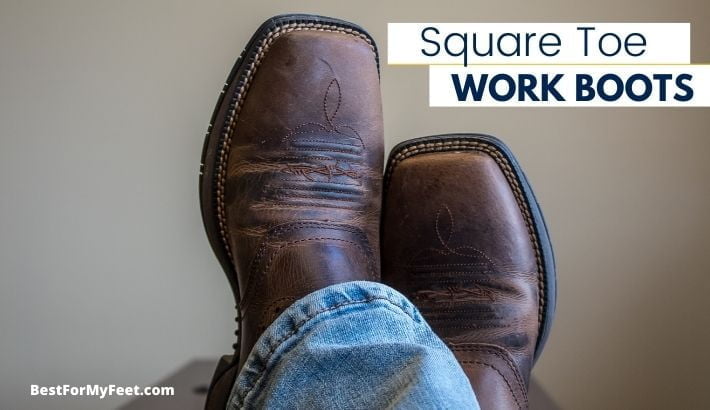
a pair of work boots that come with a square toe cap

Square-toe boots generally give more width for the foot, subsequently making them more comfortable than round-toe boots.

Unless you have a freakishly long middle toe (like me), the shape of the foot is quite square at the front, so the square toe prevents nipping or squashing of the toe area.

This allows shorter break-in periods and even allows choosing half a size smaller if you wish. Not only that, people with wide feet benefit.

These boots are quite popular for ranch work, where people are on their feet all day.

Instead of fitting snug against your feet, putting pressure on the midsoles and balls of your feet, they allow them to spread as they swell throughout the long days.

Also, you are less likely to trip on things, because there is little to no excess boot at the front.

What’s the purpose of the round toe in a work boot?

my pair of Blundstone work boots that come with a rounded steel toe cap

As with everything, it’s down to personal preference but round-toe boots are seen to be more attractive.

If you dress up, you’ll likely opt for a round or pointy-toe shoe or boot for formal wear.

The reason for rounded-toe cowboy boots for instance is that they are easier to get in stirrups.

That’s why the more traditional cowboy boots are round-toe or pointy-toe, whereas the more modern square-toe are beginning to take prevalence.

This will have something to do with fewer actual traditional cowboys being around now.

They are designed for more of a snug fit, so if you have narrow feet, they would be the better option.

Why do work boots have different toe cap shapes?

The simple answer is, why not?

Why are feet different shapes? Why do people have different preferences? Why don’t we all just wear the same color, shape, and style of everything?

That’s the beauty of individuality. Where there is a consumer need, retailers must provide for it, however small, however quirky.

One person might have narrow feet with long toes and trip over things easily. Another might have wide feet with squared-off toes and walk like a troll.

Either way, with boots, one size doesn’t fit all. Boots also evolve over time to coincide with the latest fashions and practicalities.

Round toe vs square toe: which one is more comfortable?

Again, this boils down to the shape of the foot, but square-toe boots are generally deemed to be more comfortable because of the room they give. That’s not to say they can’t be too spacious.

Some people say you can get away with ordering half a size smaller with square-toe boots because of the extra space.

You need to be careful of this though, as it could alter the position of the arch, which could be physically detrimental long term, particularly if you use arch support insoles.

The pressure of the arch might be in the wrong place.

Which one is better for cowboys: round or square toe work boots?

Cowboys are widely known for wearing the more traditional round-toe boots. Mainly because, as stated earlier, they are good for riding.

If you look back in history, the earliest known mention of leather boots comes from Genghis Khan’s Mongols invading Europe.

The toe was streamlined for sliding into horse stirrups to ride into battle, and the deep wooden heel was perfect for resting the foot on the stirrup. Europe inherited this style for the next few centuries.

A real boost in popularity came in the 17th and 18th centuries, with the high tops and stacked heels of English riding boots.

But we’re not wanting to know about Mongol and English riders. So we’ll talk about the golden era of cowboys. 1866-1886. So many styles of Wellington boots got manufactured for cowboys during that period.

The classic original design became the go to boot for riders, with its high top for keeping water and mud out, and the shaft that helped protect the rider’s ankle from the stirrup leather and thorns of passing bushes.

During this golden age, boot manufacturers got more adventurous, making the boots fashionable, with different materials, colors, and decorative stitching.

After a while, the cowboy era faded, and Hollywood took the reins, making the boot popular worldwide.

Hollywood made boots more stylish, taking them to a whole new level. If you look at these movies, most of the cowboys were wearing round toes. Some, even pointy toes, which wouldn’t have actually been great for cowboys.

Bottom line is, round-toe boots have a history of being best for riding, but square-toe boots are more comfortable for working on the ranch for long hours. But, as with anything, it’s about personal preference.

Square or Round toe: How to choose the best toe shape for you?

When to choose round toe work boots?

As stated before, round-toe boots are a better choice for people with narrow feet, and if you have finger toes like me.

They tend to be favored for formal wear because there are some very stylish and decorative round-toe boots.

They also sit nicely between pointy-toe and square-toe, but there are many other variations therein.

When to choose square toe work boots?

If you have wide feet that need extra room or have bunions or corns on your little toes, then square-toe boots are probably the best option, particularly if you are in them for long hours walking or working.

I’ve suffered on and off since I was a teenager with corns, and it doesn’t matter how many times I wear corn plasters. The pain can be unbearable.

They can affect the way you walk, which in turn might affect your posture, and give leg or back problems, so a little extra space to stop rubbing or tension goes a long way.

Wrapping up: Which is better? Square or Round toe work boots?

I don’t like to say which is better because it is very subjective, and naming one would give an injustice to the other. What is good for one person might not be good for another, and these two styles both have great assets.

But if you go by what we’ve covered, round-toe boots might be more suitable for horse riding because they are easier to get the foot in the stirrups and are the more traditional cowboy boot.

And square-toe boots might be better for long working days, because of the space and comfort they offer.

As with anything, it is always best to do your research. Be aware of the size and shape of your feet, and what they require.

Keep an eye on if you need to order half a size up or down depending on the boot style and how the specific work boots brands come up. Take your time in choosing.

You might be in the boots for a long time each day, so you’ll want them to last.

Whether you’re walking, working, or doing the doseedo, you wanna kick up dust in style. Hopefully, we’ll help you get that party started.

Let’s go to the ball.


Team Members Working On This Page

Jimmy Webb – Writer And Researcher

Hey, Jimmy here. I’m one of the researchers and writers here at BestForMyFeet.com.  I’ve been wearing work boots all my life working as a forklift driver, landscaper, groundworker, and now as a tower crane operator so I know a few things about footwear and footcare in general. I’m also working on my first novel. So writing IS my passion. When I’m not writing I love to spend time with my wife, two children, and furball.

Victor Adrian – Editor And Webmaster

Construction Professional, driver, crane operator, cleaner, head chef … these are just some of the jobs I did in the past. Working in all these different environments taught me that having good footwear to protect your feet from different dangers at work IS PARAMOUNT for any worker! On this website, I aim to share all my knowledge and personal experience in dealing with different footwear and foot care issues, and hopefully, you can get something out of it. Enjoy!


source https://bestformyfeet.com/square-toe-vs-round-toe-in-work-boots/

Brunt Versus Thorogood work boots: Here’s What You Need To Know

With Brunt Footwear gaining more and more traction, some of you looking into buying a new pair of work wanted to know how these two brands c...