Friday, 24 February 2023

How Many Pairs Of Work Boots Should You Have? (And Why?)

1 Pair? 3 pairs? 10 pairs of work boots? People often wonder how many work boots they should own. Well, experts such as my colleague Adrian and others advise that you should own more than one pair of work boots.

Why?

Because you can rotate between your work boots!

The amount of pairs is purely up to the individual. But it depends on your occupation, seasons, and boot moisture, among other things.

So the short answer to the question of how many pairs of work boots you should own is at least a couple of pairs. This is called Boot Rotation. In this article you’ll learn the reasons why owning more than one pair of boots for work is a good idea.

Let’s get into it…

Who’s working on this page

Jimmy Webb
Author & Researcher
Victor Adrian
Researcher & Editor

8 Reasons to rotate your work boots

As I said in the introduction, owning more than one pair of work boots is important because you can swap your work boots regularly. And that is extremely important. Here is why!

1. Break in new work boots (pain-free)

Breaking in a new pair of work boots can be torturous. Some boots can be extremely stiff from new and can take a long time to break in.

Logger-style wildland firefighting boots for example. Because of the nature of the work, these boots are built like tanks, so at the bare minimum it can take 300 hours of pain to break them in properly.

But once broken in, they fit like gloves!

This torture can be eased by alternating between the new ones and already broken-in boots. The shock to the feet isn’t so abrupt. It should lessen the number of sores and blisters.

The lobster analogy springs to mind. “A lobster thrown straight into a boiled pan will scream and jump out and hold its testicles high up. But a lobster boiled very slowly won’t realize it’s being cooked alive. It’ll chill out in the pan until it’s cooked and ready to eat.

2. Drying time

Although water is a must for things like cleaning, and more importantly, survival, it also has degenerative aspects if left in specific areas for too long.

If you think of those nasty potholes in the road, they’re caused by pooled water eroding the surface. If moisture does that to hard road surfaces, it will certainly eat away at boots.

have more than one pair of work boots is very helpful because if one of the boots get wet you can leave it to dry on the dryer while you wear the other one.

Water in the boots can come from external or internal. Rainwater getting in, or sweat accumulating from the feet. Feet have more sweat glands than anywhere in the body.

Not only can this moisture erode the boots after a while, but it can also cause blisters, discomfort, smelly feet and boots, and even conditions like athlete’s foot.

One thing water does is carry bacteria. If left stagnant, the bacteria multiplies.

Alternating the boots every day or two allows them time to dry out naturally or through gentle heat. I say this because force drying can sometimes lead to the cracking of the leather.

Adrian is using a boot dryer (PEET Original boot dryer) to dry his work boots. It’s safe for your boots and also it’s convenient.

This drying process reduces bacteria growth.

3. Climate

Boots come with or without insulation. The insulation is in different thicknesses depending on activity and climate. It’s measured in grams.

Extreme winter conditions will require heavy insulation, whereas warmer climates require little to no insulation.

having more than one pair of work boots is very helpful because you can rotate between the boots depending on the climate you're working in. Sometimes is hot, sometimes is cold.

The differences in season temperatures in some parts of the world can be quite vast, which means the necessary level of insulation in the footwear will be different.

You might also travel to many areas for work. In these places, the temperatures might vary.

Some jobs are even seasonal. You might need at least two pairs of boots to rotate during that specific work season, then maybe at least another two when doing other work while waiting for that season to start.

4. Longer life span

Let’s face it, our work boots can take a beating. The number of miles we walk, the knocks, scuffs, scratches, and exposure to the elements. After a while, all these things begin to take their toll.

owning more than one pair of work boots will expand the life span of your work boots saving money in the long run.

Owning more than one pair of boots can lessen the wear and tear, at the same time, give them a rest.

Constant compression of the midsoles might not give them a chance to recover and reform to the natural shape. Resting them from time to time allows the spongy material to retain its elasticity, which gives you the optimum support and comfort.

If the boots do break down and eventually need repairing or replacing, having a spare pair means you aren’t caught short. You’re still able to wear some while your others are being worked on.

5. Body health

Our bodies become accustomed to what we wear on our feet. If we only wear only one pair of boots, there’s no variation, so the muscles, tendons, and ligaments get used to the one specific posture created by wearing that pair of boots.

This is even worse if the boots are not particularly good for our posture.

It overloads certain components of our legs while strengthening others, which causes an imbalance. This may create problems that gradually get worse.

Interchanging the footwear makes those parts of our body adjust to different postures, which in turn makes them more fit, subtle, and well-balanced overall in terms of strength.

Also, a longer shift or more vigorous work that you’re used to can cause fatigue or soreness in the feet or legs. Boots with more cushioning or lighter weight can add some relief.

6. The correct boots for the job

Your job might include multiple aspects of work. You might even move from one area of work to another.

These different tasks might require different types of boots. For instance, on a construction site, you might want some lightweight boots for general tasks, then need to put rubber boots on to pour concrete.

The same can be said for ranches, where you might need rubber boots for wading through boggy fields, but cowboy boots for riding, or heeled boots with extra grip for climbing on and off machinery.

The heels help with things like resting on ladder rungs or horse stirrups.

The shape of the toe can also determine what you want to wear to ride. Round or pointy-toe boots are easier to get into the stirrups.

Heavy-duty boots might be too cumbersome to wear all day, so people might choose to throw them on only when doing rigorous tasks.

This doesn’t mean you should go and buy multiple pairs of boots straight away. Sometimes you just have to work with what you’ve got.

7. Boot conditioning and/or polishing

Maintaining our boots is important for longevity. Applying conditioner softens the leather and brings back the natural colors.

bootcare is an important step in making our work boots mroe durable and comfortable for longer. So having more than one pair of work boots will allow you to condition and take care of one pair of work boots while you still can go to work wearing the other pair you have.

This and polishing also help with water resistance. They create a thin protective barrier.

But when doing these tasks, the key is to allow proper drying/resting time, which lets the treatment fully soak into the leather.

This might not be possible if we’re using the boots constantly. Especially when limited for time. You know what it’s like with family and commitments. Sometimes we don’t get time to fart, let alone anything else.

This is why rotating boots gives you a chance to set aside the boots that need treating until they’re done. Or even when they have been treated and need time to settle in.

8. Trying out different brands

You might be used to using the same brand all the time. But sometimes it’s good to check out different brands.

Alternating between two different brands gives you a chance to compare the two. And if you don’t like one, you can just stick to the one you’re familiar with.

Last notes

I’m afraid I can’t answer the specific question in the title of this article. How many boots we should have is anybody’s guess. It really does depend on a wide range of things.

Hopefully, those things have been covered to help you come to your own conclusions. Because, at the end of the day, it’s up to the individual.

But I think we’ve established that having two or more pairs of boots is beneficial. And we’ve covered why.

With that being said, it might not be affordable to go out and buy two or more pairs of brand new boots right off the bat. Don’t worry, you don’t have to. Once one pair have been used for a while, then you can think about getting more.

You could even get a pair of cheaper work boots to rotate while you’re doing whatever you need to do with your regular ones. But I wouldn’t stress about it. As long as you’ve got something on your feet to keep you going to earn your crust.

That’s all from us. As always, please do contact us if you have any questions, or would like to share your own experiences. Feedback from consumers is always useful.

Take care.


Team Members Working On This Page

Jimmy Webb – Writer And Researcher

Hey, Jimmy here. I’m one of the researchers and writers here at BestForMyFeet.com.  I’ve been wearing work boots all my life working as a forklift driver, landscaper, groundworker, and now as a tower crane operator so I know a few things about footwear and footcare in general. I’m also working on my first novel. So writing IS my passion. When I’m not writing I love to spend time with my wife, two children, and furball.

Victor Adrian – Editor And Webmaster

Construction Professional, driver, crane operator, cleaner, head chef … these are just some of the jobs I did in the past. Working in all these different environments taught me that having good footwear to protect your feet from different dangers at work IS PARAMOUNT for any worker! On this website, I aim to share all my knowledge and personal experience in dealing with different footwear and foot care issues, and hopefully, you can get something out of it. Enjoy!


source https://bestformyfeet.com/how-many-pairs-of-work-boots-should-you-have/

Wednesday, 22 February 2023

Are There Any Work Boots That Have A Lifetime Warranty? (Or It’s A Myth?)

Today we’re going to talk about a controversial topic. Work boots with lifetime warranties. Controversial in the sense that many people don’t believe these boots exist.

We happen to have found some work boot brands that do offer this service. But, are there loopholes? Is it a viable business practice for companies? Are any repairs that are done of good quality?

I’m not sure we have the answers. But we can tell you what some of the brands’ policies are. And we can give some first-hand consumer opinions and experiences.

Who’s working on this page

Jimmy Webb
Author & Researcher
Victor Adrian
Researcher & Editor

What is a lifetime warranty?

This is where things can get confusing, or where people dismiss the idea.

Each manufacturer or seller of a product will have their own version of what this entails.

But a warranty is a promise from the manufacturer/retailer that the product will meet certain specifications.

This promise means they’ll turn your faulty product into a well working one. This isn’t necessarily by replacing the faulty product with a new one, which is what some people assume. It may be a case of repairing.

The word ‘lifetime’ can easily be misconstrued. And it also varies.

It can mean:

  • The lifetime of the product, from when it was bought to when it completely gives up on you.
  • The lifetime of the company making or selling the product. If the company doesn’t exist anymore, they’re not available to repair or replace the product.
  • The length of time the manufacturer continues to make the product. If a product is discontinued, the warranty liability of the manufacturer is usually specified in the warranty documentation. (You’ll find that this will be very difficult to determine with work boots).

Certain conditions are usually put in place to make sure the product (boots in this case) is eligible to activate the warranty. The warranty is usually only eligible for boots that have issues that are down to craftsmanship or material defects.

They don’t usually accept liability for general wear and tear, neglect, cuts or abrasions, or burns. Each brand will have its own requirements.

What work boot brands offer lifetime warranties?

Based on what we walked above, here are some brands that offer lifetime warranty for their work boots:

L.L. Bean.

Although L.L. Bean’s warranty policy isn’t clear on their website, research led me to believe they offer a lifetime warranty, so I contacted them.

They kindly sent me an email saying:

“We stand behind all our products and if you are not 100% satisfied with one of our products purchased directly from L.L.Bean, you can return it or exchange it within one year with proof of purchase in most cases. After one year we will consider items that prove to be defective due to either materials or craftsmanship.”

This basically means that they will happily replace boots within the standard one-year time period that most brands give.

But after that year, they will be selective about what they compensate for, as long as the defects are due to materials or manufacturing faults.

The question is how long after the one-year period do they consider items for? A lifetime? It’s not very clear.

If I have a pair of L.L. Bean’s boots until the rest of my days and contact them when I’m wetting myself in my retirement home at 90, will they oblige if they’re still in business? Who knows?

HISEA

Now, here is a brand that gives a little more detail about their policy on their website. HISEA offers a lifetime warranty that you have to register for.

This warranty doesn’t cover wear and tear. It covers manufacturing defects in materials and workmanship, regardless of the age of the boots.

However, they do offer a one-year warranty on all HISEA products without any conditions. I’m assuming that includes wear and tear. But that wouldn’t make sense to me from a business point of view. I think they need to be more clear about this.

Boots that are registered under their lifetime warranty get replaced if damaged or broken unintentionally. But each purchase only has access to one replacement during the warranty.

In this case, is it really a lifetime warranty if only one replacement is allowed?

If the cost of repairing the boots exceeds the cost of new ones, then they’ll just replace them.

Damaged boots covered under warranty are usually replaced free of charge.

Damage not covered under warranty might also be free in some cases, but they will request that you pay for the shipping cost of your returned boots, while they cover the cost of the replacement boot shipping.

You should expect to receive your replacement boots in 3-7 working days, depending on where you are.

Chaco

If a Chaco product has defects in materials or the quality of their workmanship, they will promise to repair or replace it free of charge for the entire life of the product.

As with every brand, they have their guidelines for this warranty.

These guidelines are quoted from the website here:

  • Chaco products must be evaluated by our specialists first-hand for warranty determination.
  • Warranted products are replaced at Chaco’s discretion.
  • Warranty does not apply to problems with fit.
  • Warranty does not cover wear and tear.
  • Products worn past the point of repair will be void of warranty coverage.
  • Products modified or repaired outside of Chaco or by a Chaco-certified cobbler will be void of warranty coverage.

If after assessment Chaco determines the defect isn’t covered under warranty, they will charge you for a boot repair, if you wish the repair to go ahead.

Dr. Martens

Unfortunately, Dr. Martens stopped doing their For Life collection in May 2018. This was a line of footwear of which Dr. Martens were so confident about, they offered the opportunity to have a lifetime guarantee.

However, they will still honor all existing For Life guarantees for boot owners who purchased their boots before April 1st 2018 and registered by May 31st 2018.

Who knows why they discontinued this service?

Maybe they found that their boots weren’t quite suitable for some industries, so they didn’t last too long. Maybe people abused the service. Maybe too much money was being lost.

After reaching out for public opinion on Dr. Martens and their For Life guarantee, people kindly got back to me with two completely opposing experiences.

One person has had their boots for 10 years and claims that they’re still a long way off replacement. The boots were made in Taiwan, and were the best Docs boots they ever owned.

Another person, however, claimed that their boots were s**t. One pair lasted one day. The eyelets fell out. Two other pairs had faulty leather.

And they ended up returning 7 pairs due to faulty construction. They were glad to be rid of them. They moved to more expensive work boots like the PNW work boots made in America and couldn’t be happier.

To be fair, this contrast of opinion could probably be said for any product made by any brand anywhere in the world. I don’t think it means that Dr. Martens doesn’t make a decent boot.

I mean, they’ve been going a long time and are very popular. I just think that maybe they’re a very decent fashion brand that tried to venture into work boots and it possibly didn’t quite work.

My colleague Adrian from the editorial team tested the Dr. Martens Icon safety boots.

He agrees that the boots are not the best option when it comes to heavy-duty industries but that doesn’t mean they might not be a good boot for someone working in a warehouse or in the yard for example.

Patagonia

Patagonia, a company that specializes in outdoor wear, has a small line of specialist waders and boots.

All of their products come with an Ironclad Guarantee. This guarantee allows you to return the boots to the store for a refund, replacement, or repair if you’re not satisfied.

Damage due to wear and tear can be repaired at a reasonable price. Returns received after the stand one-year period are refunded with a Patagonia merchandise credit.

You can use this credit to purchase items online or in-store.

There is no time limit for returning an item. However, they ask that returns for size and color are made in a timely manner and that those items are kept in new condition with tags attached.

Any issues that are due to manufacturer or material fault are repaired free of charge. They offer this service for any item, old or new, bought online or in a store.

What does the public say?

I had some fascinating conversations within certain subreddit boot communities about lifetime warranties on work boots.

Some people had faith in them, some were very skeptical, and others thought it was a completely impossible and impractical idea.

One person said that they don’t know what value a lifetime warranty would have, in real terms. Because material or manufacturer defects get noticed pretty much straight away.

The odds of these defects becoming apparent years down the line would be pretty much nil.

They make a good point. After years of boot use, how does a manufacturer decide if the defect is a fault in material or workmanship, or if it’s wear and tear?

I think the line is very thin. Particularly with boots that, in some jobs, really go through the mill.

There are companies who are willing to help you out.

A couple of people commented to me that they had free repairs done by brands like Red Wing and Blundstone after their standard 12-month warranties expired.

In fact, one person, a pipe fitter working in industrial and commercial settings, claimed that their Red Wing Supersoles had stitches, toe caps, laces, and leather treatments all sorted for free.

They’ve had the boots for 4 years and expect another 2. They said that most of their crew take their Red Wing boots in a couple of times a year to get fixed and cleaned up.

Conclusion

Unfortunately, after extensive research, we couldn’t find many brands that offer lifetime warranties. Apologies for this. But at least you now have an idea of what exactly a lifetime warranty is.

As I’ve already said, personally, I think there is a very thin line as to what could be determined as either material and workmanship faults or wear and tear.

Companies could easily blame defects on wear and tear. Especially if they’re not reputable.

Another thing that could be questionable is the quality of the repair from the company.

If it’s free under warranty, will they take as much care and consideration as when a customer pays for a repair?

For example, during my subreddit conversations, one person who works in a store had a customer take in some Red Wing boots that had been repaired under warranty.

The store worker was appalled by the standard of the repair. But this could be down to the branch that does the repair. He knows of a place a couple of hours from home that has a terrible reputation.

This is a good time to advise you to research the places that you want to take your boots to be repaired. One place could be really good, but the next could be awful.

There’s no point in having warranty repairs done if they’re going to fall apart again in a few days or weeks. This is how disputes can happen between supplier and customer.

That’s it from me now. I hope you’ve found the article useful. I certainly learn a lot from each one I write.

I think this is a perfect article to hear about your own experiences with lifetime warranties. Or even repairs or replacements that have been done outside of the warranty. So please reach out to us over social media. We’d love to hear from you.


Team Members Working On This Page

Jimmy Webb – Writer And Researcher

Hey, Jimmy here. I’m one of the researchers and writers here at BestForMyFeet.com.  I’ve been wearing work boots all my life working as a forklift driver, landscaper, groundworker, and now as a tower crane operator so I know a few things about footwear and footcare in general. I’m also working on my first novel. So writing IS my passion. When I’m not writing I love to spend time with my wife, two children, and furball.

Victor Adrian – Editor And Webmaster

Construction Professional, driver, crane operator, cleaner, head chef … these are just some of the jobs I did in the past. Working in all these different environments taught me that having good footwear to protect your feet from different dangers at work IS PARAMOUNT for any worker! On this website, I aim to share all my knowledge and personal experience in dealing with different footwear and foot care issues, and hopefully, you can get something out of it. Enjoy!


source https://bestformyfeet.com/what-work-boots-have-a-lifetime-waranty/

Tuesday, 14 February 2023

Does An Employer Have To Provide Work Boots? (What You Need To Know)

Personal protective equipment (PPE) isn’t cheap. Some of us can’t afford to keep buying work boots all the time.

But it’s essential for our safety in the workplace. So who is responsible for paying for work boots? Is it the employer’s responsibility to supply them? Let’s find out.

wearing a pair of boots at work that my employer paid for.

After years of debate, on May 15th, 2008, The Occupational Safety and Health Administration (OSHA), ruled that employers are required to pay for their employee’s PPE.

But that answer isn’t as simple as it seems. The ruling is subject to certain things. There are gray areas and other things to highlight.

This article should tell you all you need to know.

Who’s working on this page

Jimmy Webb
Author & Researcher
Victor Adrian
Researcher & Editor

Are work boots part of PPE?

PPE is any clothing or equipment that helps prevent injuries when working around certain hazards in the workplace.

This even includes non-clothing items like earplugs, goggles, fall-arrest harnesses, respirators, etc.

The boot protection can come in a number of forms. To name just a few, there is toe protection to:

  • protect toes from falling objects or crushing
  • electric-hazard resistance for people working around static electricity or live electricity ( for example electricians or linemen)
  • oil-and slip resistance
  • fire or heat resistance (for example firefighters, road maintenance, or roofers just to mention a few)
  • and much more

So yes, work boots are considered PPE, depending on your industry and the risks involving doing your job.

Significant hazards

The standard OSHA ruling is that employers are required to supply all PPE, including work boots, when they are used to comply with OSHA standards.

This means when there are possible hazards that risk causing harm to the employee. These are classed as significant hazards. This is where specialty safety boots may be required.

In this instance, the work boots must be totally free to the employee.

Exceptions you might want to know about

But there are exceptions to this, for example…

Taking the boots home

If the employer allows the employee to take the boots home, then the employer doesn’t have to pay for them.

But if they do not permit the employee to take the boots home, then they are required to pay for them.

This is a legal requirement under federal rules (29 CFR 1910.132(h)).

Doctor’s note/Prescription boots

This is all good and well, but what if for whatever reason the employee needs to wear specially-made boots that are outside the norm?

For example, boots designed for foot conditions or disabilities. Is the employee required to provide a doctor’s note or prescription?

In this case, there could be specific regulations for each situation. For instance, some might fall under the Americans with Disabilities Act.

The general rule of thumb is that – bearing in mind that the employer’s duty is to identify workplace hazards and provide footwear that will reduce risk of injury caused by those hazards – if the prescribed specialty boot does not provide adequate risk reduction, then the employer would not be required under this particular regulation to provide those boots.

But, depending on what condition or disability the employee has, and the nature of the prescription, some situations could be reasonable enough to be accommodated by the employer.

What is boot allowance?

This is where, rather than an employer handing to the employee work boots that they’ve purchased, they pay a maximum of $200 a year to each employee (depending on the company, they might have a lower or a higher boot allowance) upon receipt of boots that those employees have purchased.

This allowance is a reimbursement for the purchased boots.

This is useful to the employee because they might not like or feel comfortable in standard issue boots provided by the employer.

This way they can choose boots that fit their taste, style, comfort, and most importantly, be best suited to the jobs they do.

To give you an example, some companies have divisions, but still, send out the same standard issue boot to all those divisions.

But a light-duty worker might need a lightweight soft-toe boot work boot without too many safety features, whereas a hard-duty worker might need heavy-duty boots, or a specialist tradesperson working with lots of hazardous elements might need all singing and dancing boots.

OSHA is ever evolving their regulations to try to make things better suited and more practical for all parties. They are now encouraging employers to consider paying for ordinary work boots (i.e. non-safety).

If it’s absolutely necessary to have them, or is a matter of practical safety, employers will sometimes introduce payment programs that cover either a portion or all of the cost of the boots.

Like with anything that is given away for free, some companies will keep these options quiet. You might only hear about them through colleagues that have been there longer.

Don’t be afraid to ask your employer about any payment plan or other PPE provisions they provide. After all, they have a duty of care to you.

What happens if the employee does supply their own boots?

If the employee supplies their own boots, whether it’s at their own expense or reimbursed by the employer, it’s the employer’s duty to make sure the chosen boots are adequate and provide enough safety for their job.

Editor Note

Quoting OSHA federal rule CFR 1910.132(b):

“Where employees provide their own protective equipment, the employer shall be responsible to assure its adequacy, including proper maintenance, and sanitation of such equipment.”

Are safety boots a legal requirement?

Federal law only requires that safety footwear is worn where there are real risks of injury.

However, you’ll find that some companies ask employees to wear safety boots at all times – even in areas that cause no risk of injury – when it’s not really possible throughout the day for employees to change in and out of their safety boots when entering or leaving PPE necessary areas.

Exemptions

Other than boots that don’t provide enough prevention from injury, employers are not required to provide non-specialty boots, safety-toe boots, logger boots, and boots with built-in metatarsal guards.

OSHA figured that these types of safety footwear are bought to fit one person and are often worn off site (this comes under the taking the boots home bracket).

But more specialized safety boots, like steel-toe rubber boots or ones with non-slip outsoles still fit under the regulated category.

Last notes

As you now see, there are some ifs, buts, and maybes when it comes to whether the employer should pay for your work boots or not.

It’s best to keep an eye on the gray areas, because they sometimes change shade, change colors completely, or even camouflage just to confuse you.

Bottom line is, your feet are your money makers, so you need to take care of them. If you’re unsure of your company’s policy, just ask. You might as well try to get freebies.

My old man has a few sayings. One is, “If you don’t ask, you don’t get.” So I’ve been brought up pushing my luck asking for anything. I have more front than Blackpool beach. (Sorry, a British saying)

Another saying he uses is, “If someone offers you something for cheap, take it. If they offer you something free, take two,” Suffice to say, he has a garden absolutely rammed full of junk that he’ll never use. But you get my point.

We hope this has cleared a few things up for you. If not… Well, pay more attention. You should be ashamed of yourself.

Seriously, if you have any questions, drop us a line, hook up with the main man Adrian. He loves to chat. He’ll talk the hind leg off a donkey. (Sorry. Another British saying).


Team Members Working On This Page

Jimmy Webb – Writer And Researcher

Hey, Jimmy here. I’m one of the researchers and writers here at BestForMyFeet.com.  I’ve been wearing work boots all my life working as a forklift driver, landscaper, groundworker, and now as a tower crane operator so I know a few things about footwear and footcare in general. I’m also working on my first novel. So writing IS my passion. When I’m not writing I love to spend time with my wife, two children, and furball.

Victor Adrian – Editor And Webmaster

Construction Professional, driver, crane operator, cleaner, head chef … these are just some of the jobs I did in the past. Working in all these different environments taught me that having good footwear to protect your feet from different dangers at work IS PARAMOUNT for any worker! On this website, I aim to share all my knowledge and personal experience in dealing with different footwear and foot care issues, and hopefully, you can get something out of it. Enjoy!


source https://bestformyfeet.com/does-an-employer-have-to-provide-work-boots/

Sunday, 12 February 2023

Does Birkenstock Make Work Boots? (Spoiler: They Do)

Do you have clothing or footwear brands that you like and wonder if they make work boots? There might even be well-known or funky brands that make you think, “If they make work boots, I bet they’re pretty cool.”

Well, this article is looking at one of those funky brands.

Since forming in 1774, Birkenstock have spread their wings from Germany, where they were born, to go on and make sandals, shoes, and other types of footwear.

But do they make work boots?

Although Birkenstock makes various styles of safety shoes, they only sell one safety boot.

But it doesn’t seem to be available in the US. You’ll find it on their Australian website and some of their European sites. Below, I’ve given you a link to the UK site.

Who’s working on this page

Jimmy Webb
Author & Researcher
Victor Adrian
Researcher & Editor

What exactly is a work boot?

Birkenstock does make a work boot, among other things, but we have a bit of a surprise up our sleeves when we delve into what they have in store.

People might think that what they sell aren’t really work boots. So let’s define what exactly a work boot is.

Work boots are commonly associated with the Bob the Builder type, but he isn’t the only person allowed to wear them.

Work boots are for anyone who goes out to earn money while wearing boots. But also for anyone just doing some work at home.

You could be the builder type who needs rugged, hard-wearing boots. Or a security person who might want lightweight tactical boots for patrolling and possibly chasing.

You might be the archeologist type who goes out on mud, sand, rocks, or whatever.

You could be a person who stands with a sandwich board all day, but in the cold and snow and rain, so you have to wear boots to keep your feet warm.

So, now that’s out of the way, let’s get to it.

What boot does Birkenstock sell?

Birkenstock sells lots of different styles of boots. A lot of them look like casual boots, or for dress. But the question is, can they be used at work?

Of course, they can. Depending on what work you do. Before we get to the surprise, let’s have a little look.

1. Birkenstock Jackson Boot

Here is a comfortable oiled nubuck boot that has a thermoplastic rubber sole and the cork footbed that’s traditional to Birkenstock.

a pair of Birkenstock boots, model Jackson.

The cork inner sole is the original Birkenstock design. It’s built for extreme comfort. You’ll notice that the insert curls upwards at the edges, similar to orthotic inner soles. This gives the foot extra stability when walking.

There is technology along the middle of the footbed that stabilizes the foot’s metatarsal bone. This arch support system helps to give the foot a natural straight and solid stance.

And the heel mold helps to activate the calf muscles, keep the back of the foot stable, and improve gait and coordination. (Gait is the way that we walk).

This boot isn’t for someone who does rigorous work. There are no safety features that will protect you on construction sites. But it will keep you comfortable doing light duties.

Truck drivers might find this boot useful. But I’ve seen similar used by car ticket inspectors, and other occupations that involve walking a lot.

2. Birkenstock Stalon Boot

Ah, the Chelsea style. As a slip-on, this boot is so convenient for people who want to….well….slip them on and off quickly.

I’ve seen truck drivers wear these a lot (I’m talking about slip-on boots in general, not about the Stalon model in particular). Especially those who go to construction sites.

They wear them in the truck, then when they drive onto site, they quickly change into their safety boots before getting out of the truck. Simple, easy, and comfortable.

On the other hand, this boot could be used for both work and casual wear. Although, the robust build and rugged thermoplastic sole set it apart from a lot of other casual footwear.

It’s a great choice if you’re in the retail or fashion industry or any industry for that matter where a safety work boot is not required in order to do your job.

The footbed, being the same as the Jackson boot, is the heart of all the Birkenstock models.

This boot comes in Black, Graphite, Mocha, and Sandcastle.

Now let’s see some safety work boots options…

3. Birkenston QS700 Safety Boot

There are no safety boots OPTIONS…it’s just one option, one boot as I’ve mentioned at the beginning. And this is it. The Birkenstock QS700.

This isn’t your conventional safety boot. This is different.

The QS700 boot is part of what’s become somewhat of a movement. It’s a barefoot boot, or minimalist boot, whichever you want to call it. Not only that, it’s a zero-drop boot.

What are barefoot and zero-drop boots?

  • Barefoot boots

These are boots that are designed to, as much as possible, make you feel like you’re walking around barefooted.

The materials are so “minimalist”, it makes them really lightweight, really, flexible, and really comfortable.

  • Zero drop

These are boots that keep both your heel and ball of the foot at an equal distance to the ground, just as they are when you walk barefoot. Except, in the boot, there’s a sole between.

A wedge or heeled sole raises the heel higher than the toes and ball of the foot.

Now let’s look at the QS 700. This is often interpreted as a shoe.

Birkenstock refers to it as an ankle-high sneaker. The fact that it’s ankle high, to me and many others, makes it a boot.

Here are the key features of this boot:

  • Steel-toe protection (200 joules)
  • Abrasion-resistant toe covering
  • Penetration-resistant outsole
  • Metal-free outsole
  • Slip-resistant
  • Oil-and-fuel-resistant outsole
  • Water-resistant microfiber upper
  • Cork-microfiber footbed
  • Energy absorbing heel
  • Anti-static protection

I don’t know about you, but this seems like a shed load of features, even for a safety boot. And at £140, which is equivalent to just over 168 USD at the time of writing, I’d say that it’s quite a bargain.

But would it stand up to the most rigorous jobs? I’m not so sure.

Would the bottoms of your feet be comfortable over rocky or really rough terrain? Probably not.

Okay, the outsoles are puncture resistant, but I still think that the digging in of those lumps and bumps would take its toll after a while.

However, all this does is show that they’re not designed for jobs in those particular conditions.

I bet they’d be absolutely fine for lots of other jobs. Like jobs that need flexibility, and put your feet in awkward positions.

A roofer might enjoy these boots. Treading steep roofs means having to be careful how and where you place your feet.

You need to be able to feel the surface you’re putting your weight on, for grip, for making sure not to break tiles, and avoid already broken tiles, etc.

You also need to have your feet at unnatural angles because of the roof gradients. You could be squatting, kneeling, or strategically balancing.

However, an issue with this type of boot is that it’s very niche, so there is limited availability and options. Not just with Birkenstock. There aren’t many brands at all that make them.

Benefits of minimalist boots

Here, we’ll give you a summary of the benefits of barefoot boots.

If you want a detailed account that fully goes over the benefits and downfalls, check our article, Are barefoot/minimalist safety boots worth having?

1. Wide toe area

Great for toe room. Your toes won’t get squeezed inside the box which is the case with many work boots models out there.

2. Grounding/Earthing

Research shows that there are lots of health benefits to connecting to the ground. Both physical and mental.

3. Reflexology/Acupressure aspect

These are two different things but are similar in relation to barefoot boot benefits.

Feet have lots of pressure points, so in effect, you receive a free massage. Actually, it’s better than free, seeing as you’ll be at work. You’ll be getting paid to have your feet massaged.

4. Zero drop

The heel and ball of the foot being at the same level forces the natural barefoot style of walking that has been lost since our ancestors.

5. Flexibility

Not only are your feet not constrained to the shape of the boots, but the boots also allow freedom of movement. Ideal for jobs that require being in awkward positions.

6. Cool (as in temperature)

Being minimalist, there isn’t a lot of material and added insulation to make your feet warm. This is beneficial in warm climates.

Conclusion: Can you wear Birkenstock boots for work?

My conclusion is that although Birkenstock offers options, they don’t specialize in work boots for all spectrums.

Rather, they provide quite niche products, be it the barefoot boots, clogs, sandals, etc.

Saying that the products do tend to be slip resistant and are advertised as being for workers. Mainly in the hospitality sector.

The question is, going by the examples given in this article, is the brand the right fit for you? (Pun intended).

If you’re one for nature, possibly spiritualism, health consciousness, and the minimalist approach, then you could be at the right place. Also, if you like to combine workwear with day-to-day or fashion wear.

With any boot finding quest, please do your research. And don’t just look at one source. There are many conflicting messages out there. It’s best to check a few out and come to your own conclusions.

As always, we hope this article has been helpful. Please do contact us if we have any questions, or want to share your own experiences.

I’m off now to walk barefoot over some nails and hot coal. I’ll let you know how I get on.

Take care.


Team Members Working On This Page

Jimmy Webb – Writer And Researcher

Hey, Jimmy here. I’m one of the researchers and writers here at BestForMyFeet.com.  I’ve been wearing work boots all my life working as a forklift driver, landscaper, groundworker, and now as a tower crane operator so I know a few things about footwear and footcare in general. I’m also working on my first novel. So writing IS my passion. When I’m not writing I love to spend time with my wife, two children, and furball.

Victor Adrian – Editor And Webmaster

Construction Professional, driver, crane operator, cleaner, head chef … these are just some of the jobs I did in the past. Working in all these different environments taught me that having good footwear to protect your feet from different dangers at work IS PARAMOUNT for any worker! On this website, I aim to share all my knowledge and personal experience in dealing with different footwear and foot care issues, and hopefully, you can get something out of it. Enjoy!


source https://bestformyfeet.com/does-birkenstock-make-boots-for-work/

Friday, 10 February 2023

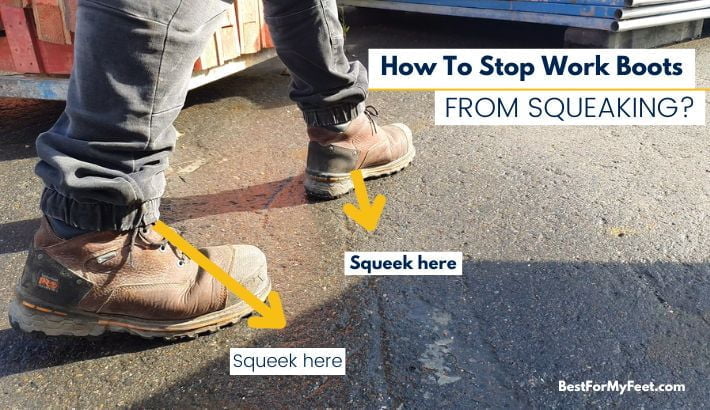
How To Stop Work Boots From Squeaking? (10 Easy Tips To Try Today)

Don’t you just hate it when the work boots you’ve spent a small fortune on, although looking the business, and are really comfortable, squeak when you walk?

I certainly do. Especially when it’s only one boot. I’d rather it was both boots or none.

Hopefully, this article will help you learn some possible causes of the squeaking, and what you can do to stop it.

Who’s working on this page

Jimmy Webb
Author & Researcher
Victor Adrian
Researcher & Editor

Why do our work boots squeak?

Because we’re ahead of the game, some of the reasons why work boots squeak have been covered in a previous article.

Here is a summary of the points covered in that article, plus some extra points.

  • Friction between the insole and outsole of the boot.
  • Friction between the rubber outsole and the surface you’re walking on.
  • Friction between the different leather parts of the boots.
  • Wear and tear from old boots.
  • Wearing the boots with no socks.
  • Water or moisture in the boots.
  • Brand new boots that are faulty.
  • Bottom of the outsole is too smooth.
  • Shoelaces generating the squeak.

Tips that will help prevent or stop work boots from squeaking

I used the word ‘prevent’ because prevention is better than rectifying, and some of the points given will both prevent and resolve the problem.

wearing my squeaky work boots on a construction site

1. Break in your work boots

When you first buy new boots, they smell nice, they look good, you just want to take them out into the world and get to work in them. This isn’t a good idea.

You should always break in your work boots first. This slowly softens and flexes the materials, molding the boots to your feet before you take them out in the elements.

using some mink oil in order to prevent my new work boots from squeaking.

2. Sprinkle Talcum powder between the insole and the footbed

When walking, try to figure out exactly where the squeak is coming from. You’ll probably be able to hear its location, but you’ll also sometimes feel the vibrations.

If you get the feeling that the squeak is coming from inside the boots, there’s a high chance it’s caused by friction between the inner sole and midsole or upper lining (the latter, if the inner sole is stiff and curls up against the lining of the boot).

In this instance, Talcum powder is a good remedy. All you do is take the inner sole out and sprinkle the powder over the bottom of the boot.

This will reduce friction. It will also remove excess moisture, keeping the boots fresh.

Let the boots rest for at least a day to absorb the powder, then dust away any excess before putting the insoles back.

3. Get some new insoles

The insoles will get old and worn. They sometimes move around inside the boots, and this rubbing can cause the squeaking.

You can get around this by either buying new insoles, or if they’re not too worn, glue them down to the footbeds of the boots (this is a pretty extreme measure though).

4. Pack underneath the squeaking area of the insole

Buying new insoles won’t guarantee the squeaking will stop. In fact, depending
on what ones you get, the new ones might even cause the noise, particularly if they’re very stiff.

I had this experience myself after fitting some really nice cork arch support insoles (the SOLE Performance cork insoles).

They’re very stiff, and to be honest, I didn’t heat them first before using them, so I would suggest doing this to mold them better and faster. From the moment I started using them, one boot constantly squeaked.

Luckily, Adrian, our wonderful editor, and webmaster, gave me a tip.

The squeaking came from the back of the heel area, where the insole curls up the boot a little. Adrian advised me to pack the area with something.

So that’s what I did. I folded a small piece of paper over and over into a strip, and placed it around the shape of the back of the heel so that the insole could rest on top of it instead of sliding up and down.

This is a simple tip if you don’t want to glue, or if you don’t want to fork out on other insoles.

4. Rough up the bottom of the outsoles with sandpaper

We’ve covered the insole. What about the outsole?

Well, most of our work boot outsoles are made of types of rubber. On certain surfaces, rubber will squeak. Think of your car tires when you go around tight corners sometimes.

Smooth, shiny surfaces are usually the culprits. Like polished concrete or tiled floors.

All you need to do is rough the soles up a little. Get some sandpaper and lightly and evenly rub it over the bottom of the soles. This will give the soles more texture, and probably more grip.

But don’t go too mad with the rubbing. You don’t want to ruin the soles.

5. Glue separated outsoles back, have them repaired professionally, or replace the boots

These soles sometimes come detached from the boots over time (also known as sole delamination). Especially at the heels and toes. Not only might this cause squeaking, but it will also give you wet feet.

Your options are to either glue the soles back on to the rubber, have a cobbler resole them for you, or buy new work boots.

If you glue them back, first clean any dirt out of the gap, otherwise, the glue will stick to the dirt rather than the surfaces. Then put masking tape next to the damaged areas, anywhere you don’t want excess glue to show. Just like you would when painting at home, or when spraying vehicles.

When all this prep work is done, use matchsticks, or something similar, to spread the glue onto the surfaces, making sure to get into all the cracks.

Hold the surfaces together firmly. You could put one hand or an object inside the boot to assist in clamping if you need to. But remember, it’s not about how long you clamp for. It’s about the firmness.

Make sure you remove the tape before the glue dries, otherwise it will be very difficult to get it off.

Some glues will require a certain amount of curing time before you wear the boots. You’ll need to check the instructions.

6. Treat the upper with oil treatment

Right, we’ve gone over the insoles and the outsoles. Now we need to cover the rest of the boot. Literally.

Softening the boot material using oil conditioning should help. Clean your work boots first and let them dry naturally or use a boot dryer, then remove the laces.

You might as well give them a clean while you’re at it. Finally, evenly apply the conditioning using a microfiber cloth.

Be sure to apply oil on the tongue as well, as in some cases, friction between the tongue and the laces could cause friction.

Editor Note

Personally, I use mink oil to condition my leather work boots.

Sometimes I use boots oil too, especially if what I’m trying to do is to waterproof my leather work boots.

Overall it seems to be a better solution for waterproofing as I’ve discovered when comparing mink oil vs boots oil but there are other leather conditioning products out there.

7. Use saddle soap on the tongue and inside the upper

using some saddle soap to help my boots stop squeaking in between tahe tongue and the eyelets.

If the noise is coming from the tongue area specifically, another trick is to use saddle soap, which is commonly used to lubricate horse saddles.

Take the laces out of the boots, then rub the saddle soup into a microfiber cloth. Hold the tongue firmly on the inside and rub the soap over the tongue and interior of the upper, around the lace eyelets.

8. Return brand new work boots if they squeak straight away

However, if your brand-new boots are squeaking straight out of the box, there’s
probably a fault.

During manufacturing, the upper and the sole is made separately, then attached together.

If this attachment isn’t done properly, or even if the soles aren’t made correctly, pockets of air can form in the sole. This trapped air can burst out of the pockets when walking, thus causing the squeak.

In this instance, it’s best to return the boots. Most boot companies will provide a warranty, but there should always be a return policy in stores within a certain amount of time.

9. Make sure the boots are always dry

Dampness can be a big problem in causing squeaking. It can come from the environment, i.e., rain, snow, etc, or from our own sweat.

You can fight this by drying your boots every day after work. This is best practice anyway, regardless of squeaking.

If your boots get consistently wet, making them too difficult to dry naturally, a quality boot dryer is an excellent investment. My colleague Adrian is using this PEET Original boot dryer. It’s a no-nonsense, cheap, and effective boot dryer.

10. Replace the boots, they got old

Finally, there comes a point when our boots need retirement. Sometimes, they get so old and battered that repairing or rebuilding just isn’t worth the effort or money.

The materials develop cracks, or the leather gets comes apart. These things can cause all kinds of funny noises, so it’s probably best to say goodbye to our old, trusted friends and make way for new ones.

It might be painful, but after a while, those old boots will be a distant memory.

In conclusion

We hope you’ve found this article interesting and informative. All the bases should be covered.

You should now know most of the reasons why work boots squeak, and lots of useful tips to both prevent the squeaking and stop it altogether.

The important thing to remember is to find the exact location of the squeaking before acting. Otherwise, you could create unnecessary expenses, or even cause other issues.

Now enjoy your peaceful walking without people staring at you. And enjoy the spring in your steps.


Team Members Working On This Page

Jimmy Webb – Writer And Researcher

Hey, Jimmy here. I’m one of the researchers and writers here at BestForMyFeet.com.  I’ve been wearing work boots all my life working as a forklift driver, landscaper, groundworker, and now as a tower crane operator so I know a few things about footwear and footcare in general. I’m also working on my first novel. So writing IS my passion. When I’m not writing I love to spend time with my wife, two children, and furball.

Victor Adrian – Editor And Webmaster

Construction Professional, driver, crane operator, cleaner, head chef … these are just some of the jobs I did in the past. Working in all these different environments taught me that having good footwear to protect your feet from different dangers at work IS PARAMOUNT for any worker! On this website, I aim to share all my knowledge and personal experience in dealing with different footwear and foot care issues, and hopefully, you can get something out of it. Enjoy!


source https://bestformyfeet.com/how-to-stop-work-boots-from-squeaking/

Brunt Versus Thorogood work boots: Here’s What You Need To Know

With Brunt Footwear gaining more and more traction, some of you looking into buying a new pair of work wanted to know how these two brands c...